A Tribute
to our
Polish Co
mrades in Arms
Polish ll Corps


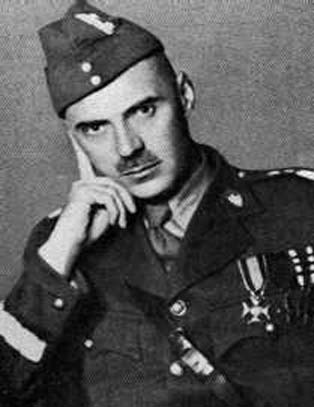
Lt Gen Wadyslaw Anders
1892 - 1970


Captured by the Russians after the partition of Poland in 1939,Anders was released from the Lubianka prison, Moscow, in 1941 to lead the Polish POWs from Russia into Persia, where the British had offered to arm and equip them to fight against the Germans in the Western Desert where they acquitted themselves with great distinction. The resulting corps, Polish II Corps, became one of the most redoubtable military formations of the war. Its principal, and unforgettable, achievement was to capture Monte Cassino, 17-18 May 1944, after three costly previous attempts had failed. Anders subsequently led it in the battles up the Adriatic Coast and in the clearance of the Po Valley.
Most of II Corps chose exile at the end of the war, and Anders remained leader of their community in England
until his death when he was reunited with his fallen comrades in the Polish cemetery at Monte Cassino.
The Polish l Corps was again formed from POWs captured by the Soviets and fought as part of the Red Army under Soviet officers. They were part of the assaulting force at the battle for Berlin. After the war, they formed the nucleus of the army of the puppet communist state of Poland.


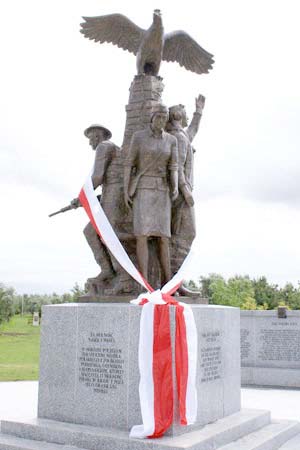
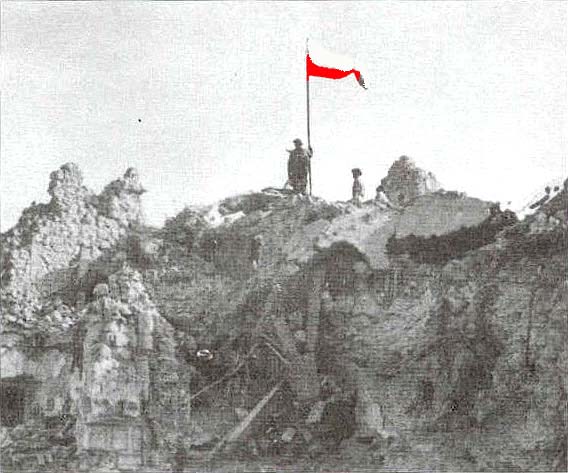
The raising of the
Polish flag at
Monte Cassino


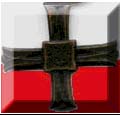
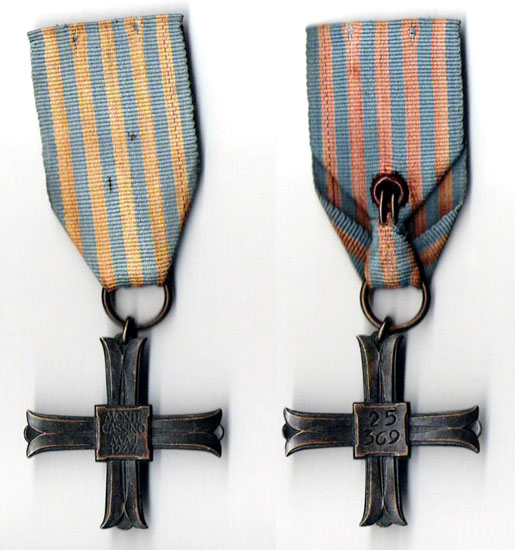
The Polish Cross
of
Monte Cassino

Lt Gen Wladyslaw Anders' tomb in the Polish Cemetery at Cassino


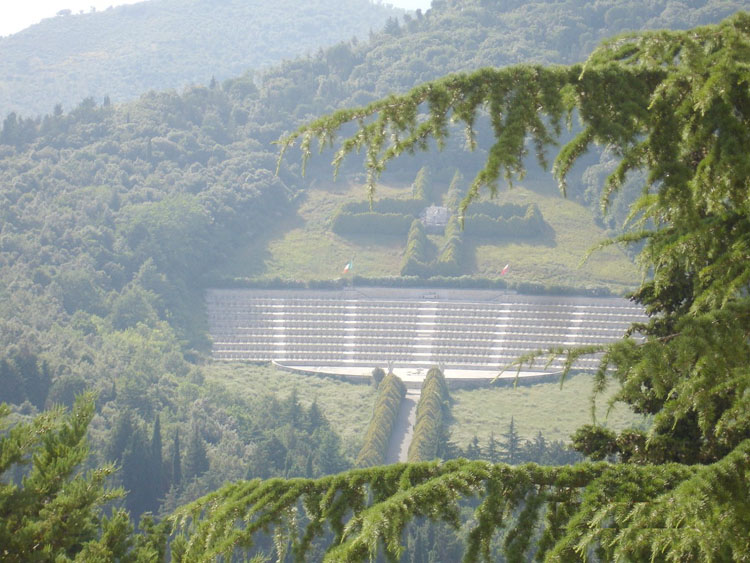
Polish cemetery at
Monte Cassino


Red Poppies on Monte Cassino
D`you see those ruins on the hill-top?
There your foe hides like a rat!
You must, you must, you must
Grab his neck and cast him from the clouds!
And they went, heedless of danger
And they went, to kill and avenge
And they went stubborn as ever,
As always - for honour - to fight.

Refrain:
Red poppies on Monte Cassino
Instead of dew, drank Polish blood.
As the soldier crushed them in falling,
For the anger was more potent than death.
Years will pass and ages will roll,
But traces of bygone days will stay,
And the poppies on Monte Cassino
Will be redder having quaffed Polish blood.
They charged through fire like madmen,
Countless were hit and fell,
Like the cavalry at Samosierra,
Like the men at Rokitno years ago.
They attacked with fury and fire,
And they got there. They climbed to the top,
And their white and scarlet standard
They placed on the ruins `midst clouds.

Refrain:
Red poppies on Monte Cassino ....
D`you see this row of white crosses?
Polish soldiers did honour there wed.
The further you go, the higher,
The more of such crosses youl'l meet.
This soil was won for Poland,
Though Poland is far away,
For Freedom is measured in crosses
When history from justice does stray.

Refrain:
Red Poppies on Monte Cassino.


Czerwone Maki na Monte Cassino
Czy widzisz te gruzy na szczycie?
Tam wróg twój sie kryje jak szczur!
Musicie, musicie, musicie!
Za kark wziac i stracic go z chmur!
I poszli szaleni, zazarci,
I poszli zabijac i mscic,
I poszli jak zawsze uparci,
Jak zawsze za honor sie bic.

Refren:
Czerwone maki na Monte Cassino
Zamiast rosy pily polska krew...
Po tych makach szedl zolnierz i ginal,
Lecz od smierci silniejszy byl gniew!
Przejda lata i wieki przemina,
Pozostana slady dawnych dni!..
I tylko maki na Monte Cassino
Czerwiensze beda, bo z polskiej wzrosna krwi.
Runeli przez ogien, stracency!
Niejeden z nich dostal i padl...
Jak ci z Samosierry szalency,
Jak ci spod Rokitny, sprzed lat.
Runeli impetem szalonym
I doszli. I udal sie szturm.
I sztandar swój bialo-czerwony
Zatkneli na gruzach wsród chmur.

Refren:
Czerwone maki...
Czy widzisz ten rzad bialych krzyzy?
To Polak z honorem bral slub.
Idz naprzód - im dalej, im wyzej,
Tym wiecej ich znajdziesz u stóp.
Ta ziemia do Polski nalezy,
Choc Polska daleko jest stad,
Bo wolnosc krzyzami sie mierzy -
Historia ten jeden ma blad.

Refren:
Czerwone maki
..


The Battle of Monte Cassino
"The red poppies on Monte Cassino instead of dew were drinking Polish blood..." the lyrics of a soldiers' song written on the battlefield commemorate one of the greatest achievements of Polish armed forces during World War II-the Battle of Monte Cassino in May 1944.
The Battle of Monte Cassino, also called the Battle of Rome, was fought on the Italian front in 1944. The Germans who defended themselves in Italy built a line of fortifications, the "Gustav and Hitler Lines," across the Apennine Peninsula around 120 kilometers to the south of Rome.
The Allies tried to break the strongly fortified Gustav Line in the Liri river valley through which they could have access to Rome. The key point of the German defense in this area was Monte Cassino with the Benedictine Abbey atop the hill.
The 15th Army Group, under Gen. Harold Alexander's command, fought on the Italian front. The Group was composed of the 5th U.S. Army, British 8th Army, including Polish 2nd Corps under Gen. Wladyslaw Anders, and French Expeditionary Corps. The enemy was the German C Army Group under the command of Field Marshal Alfred Kesselring.
Three attempts to break the Gustav Line-in January, combined with an Allied landing operation near Anzio, and in February and March 1944-ended in failure. Only the fourth attack of the Allied forces along the whole front-line was successful. The operations of the Polish 2nd Corps were decisive for the final success in breaking the German defence.
The Polish Corps' participation in this battle was important both militarily and politically. The point was to show the world that Poland, although defeated in 1939, was still fighting and to raise the spirits of the Polish people in their German-occupied homeland.
This was clearly emphasized by Gen. Anders in his assault order: "Soldiers, Time has come to start fighting. We have lived to see the moment when we will be taking revenge on our eternal enemy. The British, American, Canadian and New Zealand Divisions as well as French, Italian and Indian units will be fighting with us shoulder to shoulder. The task we have received to perform will bring glory to the Polish soldier across the world. In the belief of providence's justice, we will go forward with the holy motto in our hearts: 'God, Honour, Homeland!"
The fourth assault on the Gustav Line started on May 11, 1944. The British Army attacked along the Liri river valley and the Polish 2nd Corps launched an attack on Monte Cassino and surrounding hills. This is where select German units-a parachute division and mountain riflemen's battalions-were conducting a defense. The Polish Corps, advancing on Monte Cassino in a difficult mountainous terrain defended by numerous bunkers and minefields, suffered heavy losses. Although the first companies were decimated in bloody battles and had to withdraw, they engaged the main German forces which enabled the British troops to cross the Liri and Rapido rivers. Another attack started in the night of May 16 with the capture of the "Phantom" (Widmo) hill. During two-day bloody battles the Poles were pushing the Germans back from one position after another. At the decisive moment, Gen. Anders sent all reserves to battle-even drivers, cooks and war corespondents fought at the front line.
The Germans, facing a threat of being cut off by the Polish assault and the British troops advancing in the Liri river valley, pulled out from Monte Cassino. On May 18, a patrol of the 12th Regiment of Podolia Uhlans reached the monastery and raised the Polish flag on the ruins. Troops of the 2nd Corps chased the Germans who tried to defend themselves near Piedimonte on the Hitler Line. The Poles took over this position as well.
Thanks to the victorious battle of Monte Cassino the road to Rome was opened for the Allies. The city was liberated on June 4, 1944. Gen. Harold Alexander, the chief commander of the Italian front, had a high opinion of Polish troops: "Soldiers of the Polish Corps, I can honestly and openly assure you that if I had the opportunity to choose soldiers which I would like to have under my command I would choose you, the Poles," he wrote after the battle to Polish soldiers.
The Polish 2nd Corps paid a high price for the Monte Cassino victory-it lost 4,199 men, including 924 killed. The Germans lost over 1,100 soldiers.


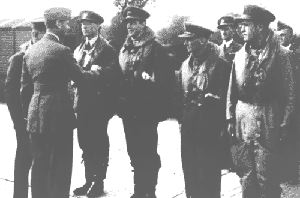
King George Vl talking to pilots of
303 Polish Squadron RAF


No 303 Polish Squadron clocked up the highest allied
scores during the Battle of Britain, with Sergeant Josef Frantisek,
a maverick Czech national and honorary Pole', becoming th
highest scorer of the Battle. In 1943, RAF Northolt's Spitfire
MK IX Squadrons became the first Spitfire Wing as a unit to
operate over Germany.
See a biography of Frantise

sent in by
Mike Murray

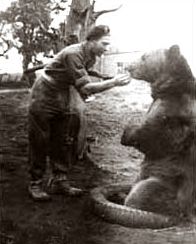
Honour sought for 'Soldier Bear'


Voytek

A campaign has been launched to build a permanent memorial to a bear which spent much of its life in Scotland - after fighting in World War II.

The bear - named Voytek - was adopted in the Middle East by Polish troops in 1943, becoming much more than a mascot. The large animal even helped their armed forces to carry ammunition at the Battle of Monte Cassino. Voytek - known as the Soldier Bear - later lived near Hutton in the Borders and ended his days at Edinburgh Zoo. He was found wandering in the hills of Iran by Polish soldiers in 1943.

They adopted him and as he grew he was trained to carry heavy mortar rounds.

When Polish forces were deployed to Europe the only way to take the bear with them was to "enlist" him. So he was given a name, rank and number and took part in the Italian campaign.

He saw action at Monte Cassino before being billeted - along with about 3,000 other Polish troops - at the army camp in the Scottish Borders.

The soldiers who were stationed with him say that he was easy to get along with. "He was just like a dog - nobody was scared of him," said Polish veteran Augustyn Karolewski, who still lives near the site of the camp. "He liked a cigarette, he liked a bottle of beer - he drank a bottle of beer like any man."

When the troops were demobilised, Voytek spent his last days at Edinburgh Zoo.

Mr Karolewski went back to see him on a couple of occasions and found he still responded to the Polish language. "I went to Edinburgh Zoo once or twice when Voytek was there," he said. "And as soon as I mentioned his name he would sit on his backside and shake his head wanting a cigarette. It wasn't easy to throw a cigarette to him - all the attempts I made until he eventually got one."

Voytek was a major attraction at the zoo until his death in 1963.

Eyemouth High School teacher Garry Paulin is now writing a new book, telling the bear's remarkable story.

'Totally amazing'

Local campaigner Aileen Orr would like to see a memorial created at Holyrood to the bear she says was part of both the community and the area's history. She first heard about Voytek as a child from her grandfather, who served with the King's Own Scottish Borderers. "I thought he had made it up to be quite honest but it was only when I got married and came here that I knew in fact he was here, Voytek was here," she said. "When I heard from the community that so few people knew about him I began to actually research the facts. It is just amazing, the story is totally amazing."

For the full story click on link below
http://www.iranchamber.com/history/articles/iranian_soldier_bear.php

Sent in by
Mike Murray
Jan 2008

Click here to go to the web site and the story of the attacks