

![]() |
RRF News |
![]() |
|
Check out
the the latest |
|
RHQ/RRF/1363 17 June 2008
ANOTHER WEEK ANOTHER FUSILIER NEWS!
1. HER MAJESTY THE QUEENS BIRTHDAY HONOURS LIST
Many congratulations go to the following who have received awards;
Col W N (Bill) Aldridge CBE who has been appointed as a Commander of the Most Excellent Order of the British Empire. This was in recognition of his leadership and example in Afghanistan where he was Chief CJ5 International Security Assistance Force and the Assistant Chief of Staff of Headquarters Allied Command Europe Rapid Reaction Corps. He is now attending The Royal College Defence Studies and his address is C/o RCDS, Seaford House, 37 Belgrave Square, London, SW1X 8NF.
Maj J W (Jim) Taylor MBE who has been appointed a Member of the same Most Excellent Order of the British Empire. This is in recognition of his specific and unique contribution to operations in both Afghanistan and Iraq over a 9 month period while serving with 2RRF. Furthermore he was instrumental in the design and delivery of a programme of improvement for command and control system for the Iraqi Security Forces in Basra.
Lt Col (Retd) E W Davidson MBE DL was also appointed as a Member of the Most Excellent Order of the British Empire. The award recognises Erics significant contribution to Charity and in particular his Citation included reference to his work for our Regimental Charities in Lancashire. He has only very recently handed over his responsibilities as Chairman of the Lancashire Area of The Royal Regiment of Fusiliers Association and he remains the President of the Royal Regiment of Fusiliers Lancashire Association Band and Corps of Drums which incidentally is at this moment in Canada playing alongside the Pipes and Drums of the Lorne Scots.
Major B R (Brian) Young MBE of the Fusiliers Army Cadet Force has been appointed a Member of the Most Excellent Order of the British Empire. He is the Company Commander of the Warwickshire Army Cadet Force and over the last 8 years has converted a struggling detachment in an under privileged area of Coventry into a highly successful unit, doubling the attendance figures and has proved to be extremely successful in recruiting for the ethnic minority communities. (Maj Young is a former TA Quartermaster of the old 5RRF).
Finally congratulations also go to Sir Alan Beith MP on his Knighthood. Sir Alan is the MP for Berwick-upon-Tweed and has for many years been a most loyal supporter of The Fusiliers.
2. FUNERAL SERVICE FOR THE LATE COLONEL PATRICK ROBINSON
The funeral service for Colonel Patrick Robinson whose death was recorded in the last Fusilier News will take place at Perth Crematorium, Crieff Road, Perth PH1 2PE at 2pm on Friday 20 June. The family will be delighted to see anybody who can make it to the service but readers should note that they intend to have a Thanks Giving Service later in the year, perhaps in September or October, in the Midlands.
3. SENIOR OFFICERS POSTINGS
Col Simon Marr MBE is very shortly taking up a new appointment as the military officer, in the Afghan Cross Whitehall Unit of the Ministry of Defence. This appointment is for three years and is a new post.
Col Philip Stack MBE currently on the Defence Planning Staff at Headquarters SHAPE has been selected for a Defence Attaché post in October, for which Language Training is starting very shortly. (Incidentally both these officers will be attending the annual Cocktail Party held outside RHQ on the 26 June) just to remind any late applicants).
4. 2ND FUSILIERS ON PUBLIC DUTIES
Yesterday, Monday 16 June 2nd Fusiliers were on parade
outside Buckingham Palace mounting Her Majestys Guard for the
first time. The parade was commanded by the Commanding Officer himself
and the Queens Colour was carried by Maj Jon Swift. Also on parade
was Maj Jeremy Lamb MC and the Battalion Adjutant. As the Regimental
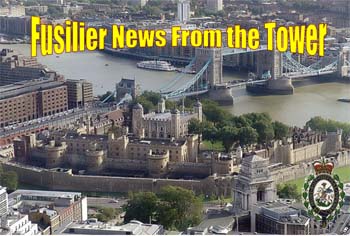
Secretary writes this Fusiliers News he can see behind him the Fusilier
sentry on guard outside the Jewel House at the Tower of London. Attached
is a photograph taken of the parade and by linking onto the following
website you can see a summary as it appeared on the Army Website;
http://www.mod.uk/DefenceInternet/DefenceNews/HistoryAndHonour/FusiliersInDebutPalaceParade.htm
5. FUSILIERS GOLFING TRIUMPH AGAIN !
The Regimental Team consisting of Col Jo Gunnell, Lt Col John Hunt, Capt David Williams and Maj Roger Antolik carried the day on 12 June 2008 at Royal St Georges, Sandwich to win the Argyll and Sutherland Highlanders Bowl by beating both the Royal Irish Regiment and, in the final, the Royal Scots. This is the infantry and cavalry inter regimental trophy, which the Fusiliers have now won for seven years, since 2002.
WJW |
|
Check
out the the latest |
|
RHQ/RRF/1363 28th April 2008
CHIEF OF THE GENERAL STAFFS LETTER TO THE ARMY
ON THE SITUATION CGS unclassified letter follows below and is
self-explanatory, outlining the conclusions of his visit to Iraq last
week but set in the context of the Campaign as a whole over the last
5 years so that no one should be in any doubt as to the current situation.
Although addressed to CinC Land Forces it is for general release. IRAQ 2. BFBS TV CLIPS http://www.ssvc.co.uk/bfbs/tv/reports/index.htm
|
|
From Lieutenant Colonel P W Merriman MBE Second Battalion
Brigadier RM Wilde CBE 12th December 06 Dear Brigadier, SECOND FUSILIERS - END OF TERM REPORT I thought that you might appreciate a concluding report on Second Fusiliers' activities this year. It has been a remarkably busy, but professionally satisfying, time and certainly one which we will long remember. You will recall that we assumed the TRB task on 1 Apr 06 and deployed A and B companies to Iraq, at 48hrs notice, on 13th April. Both companies made the best of this tour, but in truth it was not hugely rewarding for them, most of the time being spent guarding Shaiba Logistics base or the port facilities at Umm Qasr. The deployment came at the end of 7th Armoured Brigade's tour which was characterized by disengagement between the local governorate and Multi-National Forces, slowing progress in developing security institutions. Following the ratification of PM Maliki and the Iraqi National Government in May, and just as A and B Companies were returning home, the security situation in Basra deteriorated significantly with a substantial increase in the murder rate being of particular alarm; the Iraqi National Government responded by declaring a 'State of Emergency' which coincided with local reengagement between Iraqi and Multi-National Security Forces. Over a long summer, during which Second Fusiliers were otherwise engaged with the deployment of A Company Group to Afghanistan only 6 weeks after their return from Iraq, assistance to OP HIGHBROW, the evacuation of British entitled people from the Lebanon, and a high profile Defence Diplomacy exercise in Jordan, the security situation in Basra barely improved, but Coalition activity was able to greatly increase both on the ground, with a number of successful strike operations being launched to detain anti-Iraqi forces, and through engagement in Security Sector Reform. The arrival of a new GOC, Major General Richard Sherriff, under whom Second Fusiliers served with 7th Armoured Brigade in Kosovo in 2000, a new and ambitious plan was put together to drive Basrah Province towards 'PIC', Provincial Iraqi Control, the point at which the local Iraqi Security apparatus takes the lead on all security matters, leaving Multi-National Forces to provide 'overwatch', the limited support of certain specialist capabilities to routine operations and a reserve in case of a more serious threat. In order to mount OP SINBAD, as the operation became known, more troops were required; in addition to extra Engineers and other specialists, 2 rifle companies and 2 platoons of manpower were needed and a battalion headquarters to provide support to the Iraqi Security Forces command and control system. Originally envisaged as a security operation designed to root out corrupt policemen and eliminate death squads in the city, but with a palliative of reconstruction effort, the plan morphed into a reconstruction led operation, closely coupled with police reform (assessment and training) and with a disconnected, but ever present, theme of detention operations running in the background. The change was brought about by political direction from Baghdad, making the plan not just one with an 'Iraqi face', but a genuinely Iraqi plan throughout. In action the plan saw a combined force of Royal Engineers and Iraqi Engineers, local civilian contractors and International Police Assistance force personnel enter zones around the in 'pulses' of activity which lasted from 2-3 days; each pulse was accompanied by a significant security presence from Multi-National Forces and every agency of the Iraqi Security Forces, of which there are many, to bring to each area in turn a sense of what life could be like if the security situation improved, together with visible improvements to their daily lives, school improvements, streets cleaned and repaired, football pitches constructed, electricity and water projects begun, and so on to generate a belief in the providence of the central Iraqi Government and improve consent for Multi-National Force presence. After each pulse a further 28 days of increased patrolling and continuing projects by civilian contractors took place; this was designed to embed the gains won through the initial quick impact of the pulse. The police station reviews which occurred within the overall blanket of security sought to identify training and other needs for each area's police stations in turn, resulting in action plans for each. As each pulse occurred more responsibility for the planning and execution was passed to the Iraqis; by the end of the operation in mid-January it should be an entirely Iraqi activity, with Multi-National Forces providing reserves if required. Second Fusiliers contributed to OP SINBAD in three ways; Captain Andrew Swann and Sgt Halloran provided 2 multiples to work as part of Basrah City North Battlegroup (1LI, then 1 STAFFORDS), and operated directly in the focus areas of the operation, as well as carrying out the full range of patrol tasks in the city. C Company (Andrew Higgs and then Jim Taylor, WO2 (CSM) Corbett) and Fire Support Company (Gareth Boyd, WO2 (CSM) Frost) were both attached to Basrah City South Battlegroup (2 Royal Anglian, then 1 Royal Green Jackets) and, after a bit of negotiation, were given their own areas of responsibility. C Company were based in Umm Qasr, and Fire Support company operated from Basrah Palace, but with responsibilities stretching down the Al Faw peninsular. Though this tasking put them on a supporting effort, so they saw little of OP SINBAD in the city, they were much better off with their own patch to look after than spending all their time as 'rent a mob', having no fixed base to operate from. Both companies had interesting times, covering routine patrolling and security sector reform work, as well as involvement in anti-smuggling operations across the Iran-Iraq border; for C Company the hunt for the (still missing) 4 US and 1 Austrian hostages taken in November, whilst Fire Support Company needed to sit on sectarian tensions and reassure the significant Sunni minority in their area as serious spikes of violence in Baghdad threatened repercussions. The last part of the mix was to provide Battalion Headquarters to the Provincial Joint Coordination Centre to achieve short term improvements to the coordination of internal Iraqi Security Force collaboration, and coordination of the whole with Multi-National Forces, and longer term to put in place an improved system of working which would survive the subsequent departure of Multi-National Forces. The Centre was based at 'The Warren site', the former Ba'ath Party compound right in the middle of Basrah, and with the Office of the Muqta Al Sadr (OMS) a few hundred yards away. The conditions were cramped and the nature of the work involved living mixed in amongst the Iraqi Security Forces, many of whom were of mixed political allegiance and could not be relied upon. Key to the project was providing a forward headquarters for the UK brigade (20th Armoured, then 19th Light) and establishing a close relationship with the members of the Basrah Emergency Committee whose role was to bring coherence to the security forces of Basrah after the violence of the summer. The project, initially led by Jim Taylor, then Adrian Prior, became seen to be one of the key successes of OP SINBAD, and there is no doubt that the security architecture now functions far more effectively than it did when we arrived; there is a real prospect that security will be handed over to the Iraqis soon and that, unlike the experience in As Samawah and Al Amarah (where PIC has not occurred but Multi-National Forces have re-positioned away from the city) there is a very good chance that the Iraqis will be able to contain the latent threat. A functioning Provincial Joint Coordination Centre is a prerequisite to the transfer of security, but in reality our success there was a combination of three things of which our contribution to building a functioning staff was but one. Just as important was the coherence brought to the leadership of the Iraqi forces by the Emergency Committee, and our ability to shape through mentoring the direction that was being given to the Iraqi Security Forces. The last part was the process of OP SINBAD and the momentum which this gave to reform, particularly in creating a rhythm through which cooperation could be achieved and establishing a pattern, perhaps even a habit, of cooperation, otherwise anathema to the various competing organizations. Of the three, the effective command will be the hardest to sustain in the medium term since the current command structure may end with the State of Emergency. During the tour Second Fusiliers have been exposed to a variety of threats and I count ourselves extremely fortunate to come away with only one soldier (Cpl Williams) wounded. The principal threat came from Indirect Fire against bases in the City. Both the Shatt-al-Arab Hotel, where Andrew Swann was based, and the Basrah Palace, where the remainder of Fire Support Company lived, were constantly attacked. In addition to the main sites in the city we had a 'Hackle-Hub' set up at Shaiba Logistics base to coordinate our personnel and logistics activity and across all the bases we occupied there were some 200 separate attacks in which more than 600 rockets or mortar rounds exploded. There were also many blinds, and there are several stories of narrow escapes, especially from Basrah Palace which alone suffered 84 attacks in the 90 days that Support Company were based there. Ironically Cpl Williams was injured in an attack as he passed through the air base, the only location we did not permanently man. There were also encounters with smugglers in which shots were exchanged, and one with the US military in which several, thankfully, inaccurate bursts of machine gun fire were answered by a Fusilier's right hook when he got close enough to see who had been firing at him. Not ideal, but perhaps understandable in the circumstances. Those at the Warren were subjected to the most direct fire attacks, with 4 RPG and 18 other small arms fire exchanges in which we returned some 150 rounds, claiming 4 hits and with1 confirmed kill from our sniper. Our medical skills were also tested with those at the Shat-Al-Arab Hotel in particular doing an outstanding job; they were the first to treat casualties twice when mortar rounds landed amongst the tented camp they occupied for most of the tour. On the first occasion they could do nothing to help Cpl Brady, on the second they did sterling work helping some of the 10 Greenjackets injured shortly after their arrival in November. Cpl Williams was also treated by one of our own, Cpl Green and 3 others were blown off their feet by the explosion, but quickly sorted themselves out to help their colleague, who is now on sick leave in UK and is expected to be fit for work again in the New Year, his skull having healed following the removal of some shrapnel. For others the story has not been such a lucky one, and we are acutely aware that the threat from complex well planned ambushes and from Improvised explosive devices has remained extremely high. In our short time in Iraq 95 UK soldiers were wounded and 11 were killed. Turning briefly to Afghanistan, I was delighted to be able to join A Company Group in Kuwait for their decompression and to learn at first hand something of their exploits. I had not before realised, for example, just how rude the shock was that called them to action. When I left them in Camp Bastion they were contemplating two weeks 'conditioning' before operations; within 48 hours the fire support group had deployed, and as is well known defended ANP Hill thereafter for 107 days. I did not know that they had had a mere 59 minutes notice of this deployment. Amazing stuff. I understand that ITV are currently researching a 'docudrama' about them, so no doubt we will all discover much more soon. Jon Swift and his boys did a fantastic job and I am delighted that awareness of this is growing; I received a particularly good letter from Brigadier Ed Butler praising the Company and their performance and am aware that the Colonel-in-Chief also wrote to Jon praising their performance. Whilst the tour began with an expectation of force protection duties within Camp Bastion, the rapidly changing situation and stretched resources encouraged Colonel Stuart Tootal, CO 3 PARA, to employ the Fusiliers more flexibly. Once in Now Zad the Company Group was left alone to work within the overall intent of defending the District Compound against repeated attacks by the Taliban who saw ownership of the compound as a decisive effect that should be achieved even at great cost. The articles written about their subsequent exploits have highlighted the intensity of the battle for the town, the solitude and austerity of their position. Living conditions were extremely basic which, coupled with the stress of close combat with a tenacious, experienced and cunning enemy, must have been a real burden of responsibility for Jon, his officers and NCOs. During their tour, command of the area of operations passed from 3 PARA to 42 Commando. Colonel Matt Holmes immediately lifted the restriction upon their manoeuvre. Jon mounted 2 raids into Taliban controlled areas to deny by destruction firing points which had been used to harass their position for the previous 2 months. One raid witnessed one of the largest combat demolitions mounted by British Forces in years utilising 6 barmines and 45kg of explosives to reduce enemy compounds to rubble thus denying the protection that they afforded. During the 107 days in Now Zad they integrated fires from Apache attack helicopters, multinational fixed wing close air support, mortars, GPMG SF, 30mm Rarden cannon, snipers and light guns. In addition Jon took command of up to a complete Squadron of HCR formation reconnaissance vehicles, elements of 42 Commando's surveillance group and a troop of engineers. All up they called in over 30 air strikes, fired 90,000 GPMG and 1600 mortar rounds. The autonomy that the company enjoyed also resulted in close relationships with Afghan National security forces and local elders. Unfortunately not all were trustworthy and effectively had 'the enemy inside the wire' Establishing tight operational security became extremely challenging with elements of the police signalling and providing critical information about the company's dispositions and movements to the Taliban. Whilst an effective early warning system, the threat posed by these individuals became too great and eventually they were removed. The Company Group not only defended Now Zad but also provided a detached platoon elsewhere for most of the tour. In Gareskh, John Gammon's platoon provided force protection to one such outpost. They had temporary respite from that crucial but mundane task when they conducted a 10 day long range vehicle patrol under command of 3 PARA patrols platoon. After numerous contacts and lessons learned in manoeuvring around the troubled Musa Qa'lah area they returned to Gareskh until relieved by Nick Groves' platoon to deploy to Now Zad to complete their tour. That Fusiliers were a part of this historic tour is something of which the whole Regiment will feel proud. The Company Group was drawn from across the Battalion and their experiences will add great value to all of the companies. Their experiences of joint operations, particularly air / land integration, air assault, long range vehicle patrols and sustainability operations will place leaders at all levels in good stead for future commands. Currently all 3 casualties from the tour are progressing well with Drummer Barlow apparently breaking all records for rehabilitation with a prosthetic limb. From Iraq too we have gained plaudits, both in Theatre and from PJHQ: Major General Peter Wall visited to tell us that 'barely a day goes by' without some mention of what we have been up to , and with Second Fusiliers at one point in 6 operational locations in each Theatre, I was very pleased to hear it! In particular I have been pleased, again from both Theatres, to hear that the Fusiliers have something about them, a standard and a style, as well as a good humoured, but determined professionalism, which gets noticed. We are now embarked upon a programme of events designed to reintegrate the Battalion as a single organisation, and as part of this process will prepare ourselves to resume the Theatre Reserve Battalion commitment on 20th January 2007. We will see what our last few months of this task will bring; our first few have been eventful, challenging and very rewarding. So much for a sunshine tour of Cyprus! Peter |
|
Hopes and fears at Camp Bastion
By Ben Brown Special correspondent, BBC News Despite being surrounded by relentlessly flat desert for as far
as the eye can see, Camp Bastion is a little bit of Britain plonked
into Afghanistan. Amen to that. |
|
RHQ/RRF/1363 12th October
2006
OPERATIONS While not underestimating the intensity of Operations in Iraq let us start with Afghanistan. AFGHANISTAN Now that 16 Air Assault Brigade are safely back and reunited with their families and we hear their extraordinary stories in the media it is worth stating that the Fusiliers are now amongst the most, if not the most, war hardened British troops in Afghanistan. Maj Jon Swifts report for the Journal, excerpts of which I print below, make this clear. (And this time I have cleared my lines with Media Ops in London.) Maj Jon Swift with 2 Platoons of Fusiliers, Mortars, SF Guns and Snipers have now been living in their trenches within Naw Zad and on the adjacent hill for 13 weeks. Fusiliers from 3 Platoon commanded by Mr John Gammon have been securing a forward operational base in Greshk and their critical outpost securing the dam on the Helmand River. In late August two battle casualty replacements, namely Fus Clarke and Russell, were sent to the Musa Qalah outpost where they have been serving with both PARA and ROYAL IRISH comrades and have been engaged in heavy fighting. The CQMS, C/Sgt Mitchenson and a small team are in Camp BASTIAN to ensure the timely delivery of re-supplies, which are flown into the outposts by Chinook helicopters. Fusiliers are therefore deployed in five different locations across Helmand Province, although the bulk are with Maj Swift in Naw Zad. The PARAS in 16 Air Assault Brigade, who have now handed over to the Commandos after six months in Afghanistan, have been the focus of most of the media attention. However 2 RRF have provided the Theatre Reserve; thus assisting with the relief in place but proving indispensable in the process. An illustration of the intensity of operations is apparent from the figures, which were correct as at the 10th October. Naw Zad has been subjected to: 72 contacts, Maj Swifts report for the Fusilier Journal where it will be printed in full states, Despite the defensive nature of our fight, the lads never cease to amaze me. Their spirit and temperament, despite daily accurate incoming fire and casualties is a true testament to the Fusiliers and the Army as a whole. There have been casualties. Dmr Andrew Barlow who was injured in the Soviet laid minefield and which was reported in the Fusilier News of the 7th September has had to have his left leg amputated above the knee, but has shown remarkable resilience in being released from Selly Oak Hospital in record time. He is now at home, waiting for his wounds to recover sufficiently so that he can report to Headley Court Hospital for further treatment on the 22nd October. He has not been idle, however, as last Sunday he was present at Bury Metro Station where he named a new Tram on the Metro The Lancashire Fusilier (See http://www.lancs-fusiliers.co.uk/parades/Naming|0LFTRAM.htm for further details). Fus Philip Fanthome and Fus Clive Spencer have also been injured mainly from blast and shrapnel when their sangar received a direct hit from an RPG. Maj Swift is full of praise for the swift action by Cpl Herron and Fus Shocklage followed up by medical assistance from Fus Ashwell and L/Cpl Mumford who attended their wounds. Both will soon be evacuated to Selly Oak, indeed Fus Spencer should arrive there this Thursday night, with hopefully Fus Fanthome arriving this weekend. I know we are all hugely proud of these battle hardened but now pretty weary men amongst whom there are now some very mature 18 year olds who had only been in the Battalion a month prior to deployment. We anticipate them being back in Cyprus in early November. IRAQ The Weekly Rabbit is the 2RRF News Letter, sent out to families and circulated amongst the Regiment. For those minded to see photographs of life within Iraq and to hear about the Fusiliers work then assuming you have email access to Adobe Reader, you can email RHQ and we will forward it to you. When the Adjutant, operating from the relatively secure Shaiba Logistic Base tells me he still cant differentiate between the sound of incoming mortars and our own mortars firing, one can appreciate that, in Iraq too, Fusiliers are earning their medals (and their recently announced operational pay bonus). Uppermost in their minds is the end of tour date and Col Peter Merriman has again had been forced to put pen to paper. It is worth reading the extract from his letter to the battalions families which is printed below and illustrates the conundrum facing the military planners: I appreciate that what everyone wants to know is, when they will be having leave. Let me tell you what I know. There are 5 questions which need to be answered before leave dates can be set. I have been in discussion with both our chain of command in Cyprus and that here in Iraq and I am quite clear that everyone involved in making the decision is aware of all of the issues, and will make a decision as soon as they can. They appreciate in particular that leave, especially leave which is appropriately forecast and guaranteed not to be interfered with, has been in short supply this year, and I am confident that we will get the best solution available, always remembering that operational necessity is the driver. We are not here on a whim, we are here because we are needed and only when that need is reduced, or we are replaced by others, can we be released. The 5 questions, only one of which I currently have an answer to, are: When will A Company return from Afghanistan? 12 November is the given date. When will 2RRF(-) return from Iraq? Between end Nov and mid-Jan is current bracket. Who will cover the Theatre Reserve Battalion on our return? 1 LI have the commitment whilst we are deployed, but it is not yet clear if they will retain it, or pass it back to us, and if so when. Who will cover Cyprus duties on our return? The CRU is doing these at present and will continue for a while, but they are going to Afghanistan in February, so cannot do these duties for ever. When does BOWMAN start? Currently 8 January, but this will have to change if we do not return until mid- January, and may in any case be delayed as we have requested. The latest indications are that it will be disappointing if 2nd Fusiliers are not complete back in Cyprus by mid December but still no authoritative instruction has been released from PJHQ. UPDATE ON THOSE WOUNDED Fus Aveuta Tuila 2RRF is now back with the Battalion in Cyprus. L/Cpl Craig Short 2RRF is currently in England, has been released from Headley Court, and has just started attending a civilian rehabilitation course in Newcastle. L/Cpl Mark Dryden 1RRF is currently on a Football Trainers Course and is based at his home in Berwick. He is still driving his new BMW. He has a further operation on his hand scheduled for the 27 October in Selly Oak. He is getting used to his prosthetic arm. Dmr Andrew Barlow 2RRF has been mentioned in the above reports. He is currently at home prior to reporting to Headley Court on the 22 October. Fus Clive Spencer 2RRF is just arriving in Selly Oak. His parents live close by and are poised to visit him. Fus Philip Fanthome 2RRF is awaiting his condition to stabilise sufficiently so he can fly back to Selly Oak to arrive Saturday night. Currently in Camp Bastian Field Hospital. He has phoned his wife who with their young baby is in UK eagerly awaiting his arrival. There are of course several other members of the Regiment who are convalescing in UK the result of illness and road traffic accidents. Enquirers can get updates as appropriate from Capt John Davis, Assistant Regimental Secretary here at RHQ if required. 1RRF On the sporting front, the 1st Battalions Rugby players have been excelling. On the same weekend as the Fusilier Gathering, the Battalions 7s Team (The South Sea Fusiliers) won the International Munich 7 aside Tournament on Saturday 23 September 2006 (Mystery surrounds what happened to the 3,000 Euros First Prize!). Three members of the Battalion have been selected to join the British Army (Germany) Rugby Squad to play in Denmark on the 19th and 21st October. They are Cpl Trevor, Fus Tuinasakea and Fus Bower.
|
|
Posted on September 7, 2006 at 18:24:24 Fusiliers in Afghanistan update 3. FUSILIERS IN AFGHANISTAN Maj Jon Swift phoned the Regimental Secretary on Thursday 7 September.
With his 2 Platoons and Fire Support Group they remain in their outpost
in Naw Zad as reported in the last Fusilier News - a copy of which
eventually reached him in his trenches attached to a bluey
from his wife! Describing the ongoing operations involving Fusiliers and other members of 3 Para Battlegroup, Maj Swift was at pains to emphasise just how important the war fighting skills taught at the Infantry Schools were proving. Whether these were the Sniper courses, 81mm Mortar courses, GPMG SF Courses or Section and Platoon Sergeant Courses, if ever there had been any need to justify why it is necessary to send people on these courses he was witnessing it today. What is also impressive is how the interchange of skills is going on without any direction on his part. Furthermore, Blokes are sandbagging in the heat of the day and at night with no encouragement from me! His snipers had two more confirmed kills against an opposing RPG Team. His NCOs were taking notes and retaining video clips of their actions so that they can pass on their hugely beneficial experiences when they get the opportunity back in England to visit Sandhurst, Brecon and the other Infantry Schools. He questioned whether the scale of casualties was being reported in the media as the overall numbers were very significant and showing no sign of reducing. He appreciated that the current strategy was following political rather than military imperatives and anticipated that, unless it changed, his Company would likely move and be redeployed in a couple of weeks, although nothing was certain. He freely admitted that his command had been very fortunate not to have incurred more casualties since incoming mortar fire had been landing close to buildings and trenches. (Little wonder the Fusiliers are keen to increase their sandbag protection!). Mail was getting through; re-supply was working; clearly Jon Swift was hugely impressed with the professionalism being shown by everybody under his command. He ended the call by stressing that the team work and comraderie he was witnessing was exceptional and very reassuring. We should be very proud of these Fusiliers.
For 15 days those members of 2RRF not on operations in Helmand Province were waiting in Jordan for the political decision to be taken to deploy them direct to Basra. Readers may recall that 2RRF (-) went to Jordan for Exercise SAFFRON SANDS back in mid July. They fully expected to return to Cyprus in mid-September even though all ranks know that 2RRF is the Theatre Reserve Battalion until March 2007. On 22 August the CO was warned that they could expect to deploy to Basra between the 26 and 30 August for up to 4 months. Three days later, on the 25th, Lt Col Peter Merriman wrote an open letter to all his families back in Cyprus to explain the overall situation. Not until 5 September did the Defence Minister take the decision that 2RRF (less A Company in Afghanistan) would fly from Jordan to Basra this Thursday and Friday. The CO and his Command Group had been there since the 29th August. In a second letter to the families, distributed within hours of the decision being taken, the CO passed on the news, explaining that he knew how frustrating it is not to know when they will next see their husbands and when they can anticipate leave. You will hear potential end of tour dates ranging from mid November all the way through to January. You will know as soon as I know. Capt Ian Kerrigan, the Adjutant, is back in Cyprus and briefed the families this morning. The fact that it is only 9 months since C Companys last 6 month tour in Basra has not gone unnoticed. In a recent Parliamentary Question, 2RRFs failure to meet the desired Harmony Guidelines (periods of separation) had also been highlighted. As it stands, the tour length is just too short to qualify for any R & R package or the all important grant of any free flights to/from the UK for families. These frustrations however should be balanced by the recognition that the Fusiliers, Officers and NCOs are now members of a most competent, confident and professional team, in part the direct result of their recent training exercise in Jordan. Now the waiting and uncertainty is over, they can concentrate on the challenges ahead of them. This time each Company will have its own Area of Operational Responsibility and no longer be tied to static guard duties as they were when last in Iraq. 2RRFs role in Basra is that both C Company and Fire Support Company (FSP) will initially work with the Basra Rural South Battlegroup, currently the 1st Battalion, Devonshire & Dorset Light Infantry. C Company will be based at Um Qasr and FSP Company at the Basra Palace Hotel. One Platoon commanded by Capt Andrew Swann and Sgt Halloran will be based in the North of Basra at the Shatt-al-Arab Hotel working for 1 LI. Battalion HQ will be based in the centre of Basra with the role of mentoring the Iraqi command and control centre for the City. As there have been many change of appointments within 2RRF in the last month some of the key appointments are shown below:- Maj Duncan McSporran - Battalion 2IC Remaining in Cyprus will be:- Capt Hayley Dennis - The Regimental Administrative Officer Jordan Fatality 5. CIVILIAN DEATH IN JORDAN Fusiliers would wish me to convey their sympathy to Sgt Phil Stokes,
the Fusilier SNCO from Bury who has been keeping us so well informed
with the news of those Fusiliers from 4 LANCS serving in Basra. |