|
1st/6th Bn Lancashire Fusiliers Gallipoli. May 1915 - December 1915 |
|
While researching local history
around Hebden Bridge,West Yorkshire, I came across a story that may
be of interest to you (and my apologies if you have heard it already).
The poet Ted Hughes wrote a poem about WW1 called 'Six Young Men', which
was apparently inspired by a photo of six friends taken shortly before
the war.They were apparently friends of his father,William Henry Hughes,
who I believe served with 1/6 Lancashire Fusiliers in Gallipoli and
Ypres, and they enlisted in the same regiment. He survived the war,
but (according to the poem) the six men in the photo were killed.
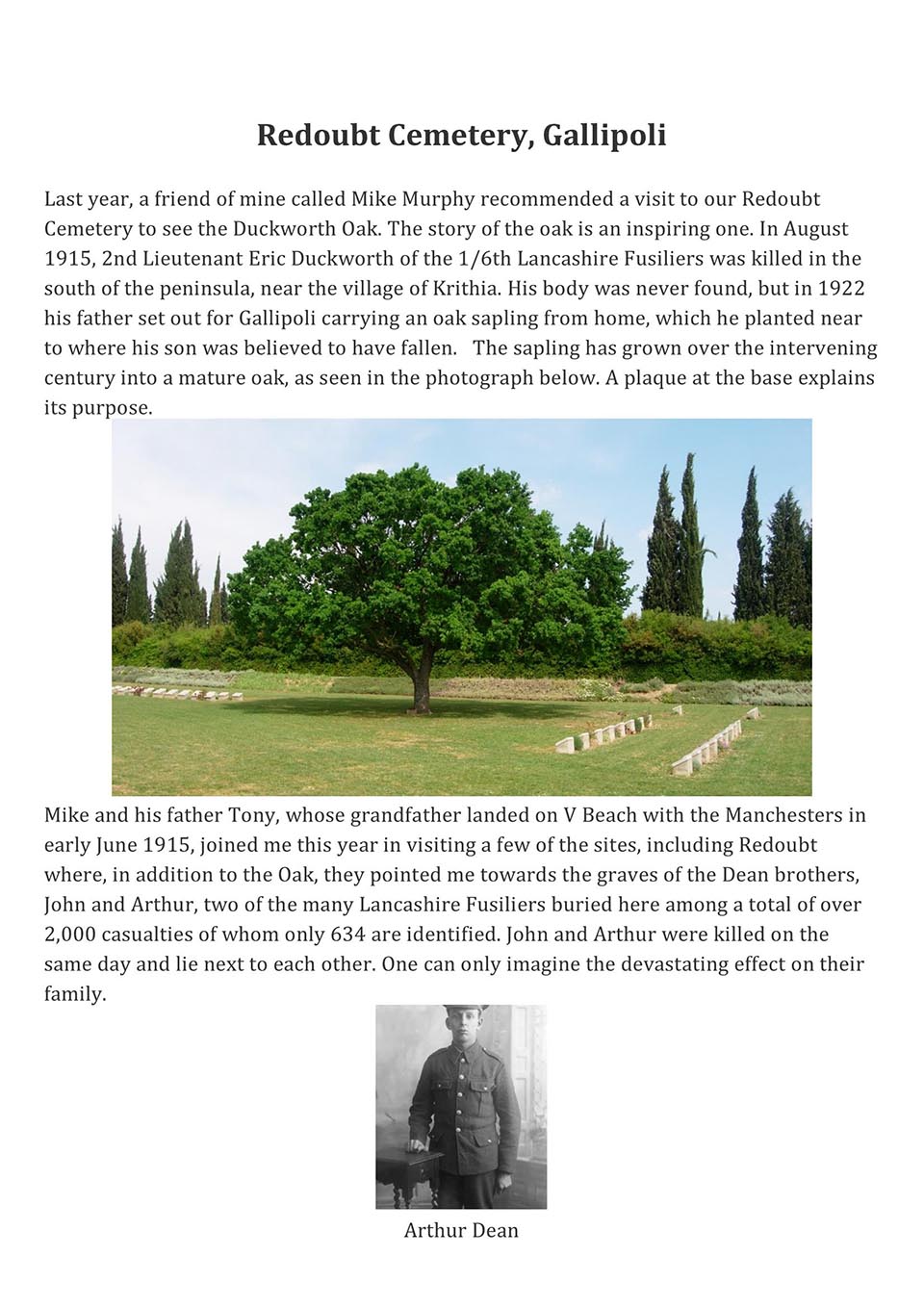
this is a photo of the 6
Young Men
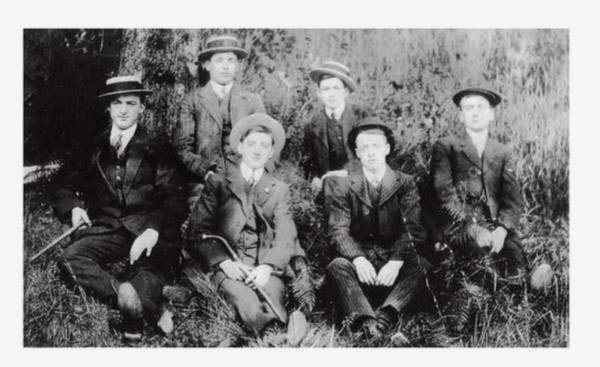
Sent in by Chris Barnett |
 |
|
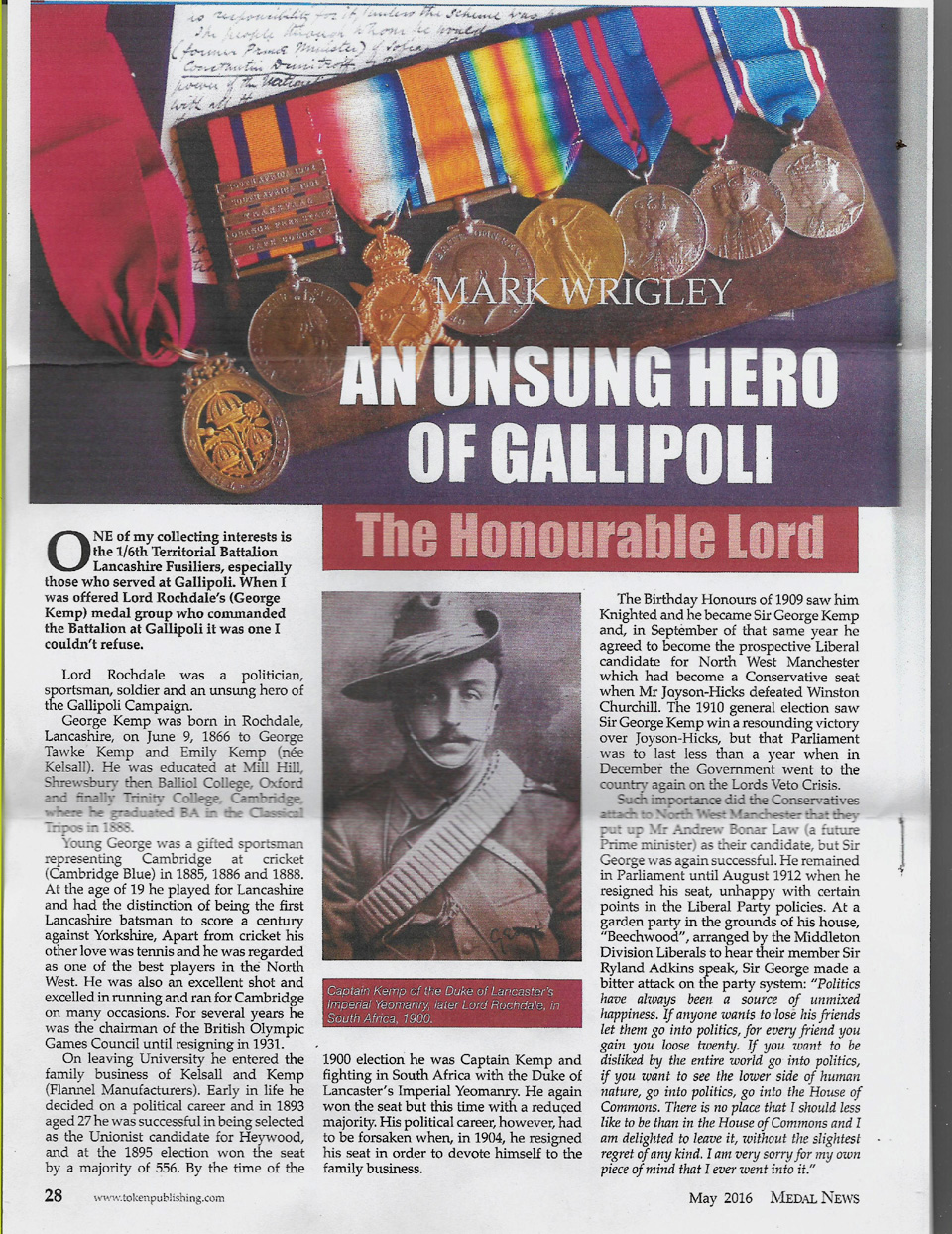
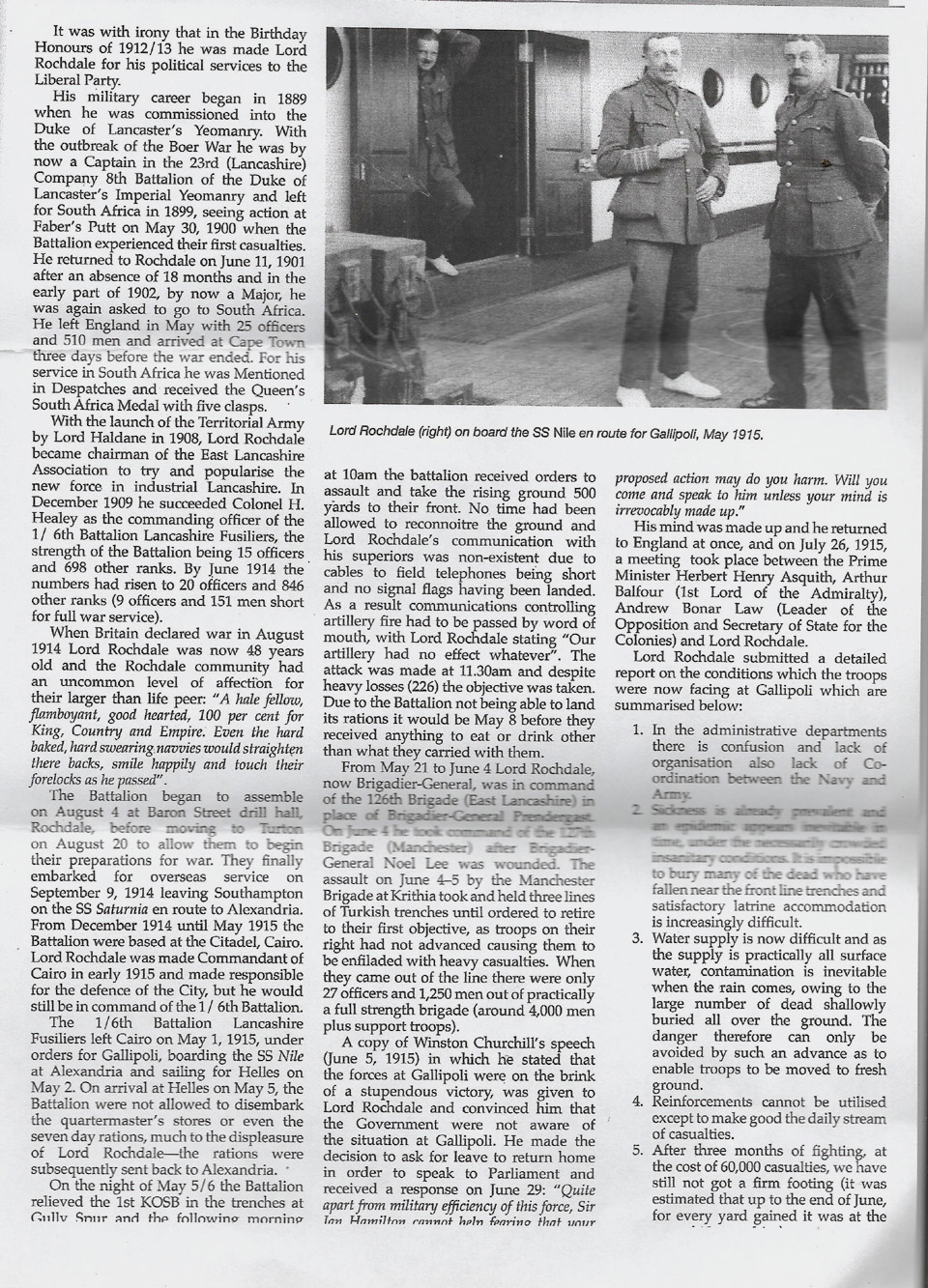
George Kemp
|
|---|
|
Died on 05/06/1915
Private Herbert Turles Two Middleton Territorials were killed on this day during 'The Third Battle of Krithia' Another son of Middleton to lay down his life in the Dardanelles was Private Edwin Broxton, son of Mrs. Broxton, Hanson Street, Middleton. He was one of the famous 6th Battalion Lancashire Fusiliers who fought at the Dardanelles, and he was killed on June 5th, 1915. Broxton who was 19 years of age, joined the Territorials in 1913. He was employed as a piecer at the Albany Mill. Private Herbert Turles, of the Lancashire Fusiliers, son of Mr. and Mrs. Turles, Boardman Lane, Rhodes, was killed on June 5th, 1915. Turles, who was employed by the Heaton Mills Bleaching Company, joined the army in 1914. He was a member of the Little Heaton Social Club. Unfortunately both soldiers have no known grave, so their names are on the Helles Memorial at Gallipoli. |
|
|
|
Died on 08/05/1915
Sergeant James Burgess Private Percy Beaman 1/6th Lancashire Fusiliers Two Middleton Territorials died on this day in 1915, in 'The Second Battle of Krithia' at Gallipoli. Sergeant Burgess lived at Shaw
Street, Middleton, and worked at the J.W. Lees Brewery. Sergeant Burgess, who suffered badly from rheumatism was told that he did not have to go into action on the day of his death. Nevertheless he had chosen to go over the top with his friends. Private Beaman lived on Church
Street West, Rhodes. And that's all we knew of Percy,
until we were fortunate to come upon Lt Norman Holden's war diary, that
his family passed on to the LF Museum in Bury. "There must have been many deeds worth the VC that day" he wrote. "Take for instance Percy Beaman of my platoon. You will read the papers 879, Beaman P. Private, killed in action. No one will know of the wounded he gave water to in the thickest fire, or the sudden fall with a chest wound, of how in spite of this, he tried to get to an NCO, badly wounded, and how he received the second and fatal wound while looking after him." A quote from Private Briggs, from Middleton, describing this battle, in a letter to the Guardian. "I lost a lot of my best friends that day. It was a day I shall never forget as long as I live. I have often heard people talk about 'hell' but I never thought I should see it." Both Percy Beaman and Sergeant James Burgess have no known grave, and are commemorated on the Helles Memorial in Turkey. |
|
Died on this day 04/03/1916
Private George Sanderson 1/6th Lancashire Fusiliers. Private Sanderson, of Reservoir
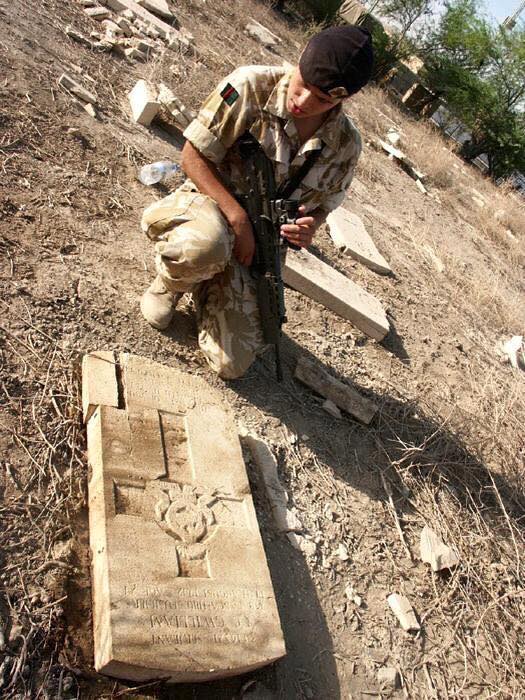
Street, Middleton, died in Egypt in March 1916. Private Sanderson is buried at Suez War Memorial Cemetery, Egypt. A sad tale today, a Middleton
Territorial who endured and survived the Gallipoli Campaign and the
evacuation to Egypt, only to die of appendicitis. |
|
Died on 13/01/1917
Private David Smethurst 1/6th Lancashire Fusiliers Private David Smethurst of
the Lancashire Fusiliers, who was taken prisoner on February 12th, 1916,
died on January 13th, 1917, at Angora, Asia Minor, from typhus. I'm not too sure on the date
of his capture, as he was probably took prisoner at Gallipoli in 1915. |
|
Died on 03/01/1918
Private John Stockport 1/6th Lancashire Fusiliers Private John Stockport, of
the 1/6th Lancashire Fusiliers, was missing on or about January 3rd,
1918, and his mother who resides at 17, Bradshaw Street, Middleton Junction,
has since received word that her son must be presumed to have been killed
on that date. Private Stockport has no known grave and his name is inscribed on the Loos Memorial, France. Mrs. Stockport suffered greatly in the war, as well as John, she lost another two sons in 1918, Albert and Robert. Albert Stockport's son, Clifford was killed in 1942 serving with the Royal Navy in WW2. |
|
Died on 10/11/1915
Private Arthur Foxall 1/6th Lancashire Fusiliers. Private Arthur Foxall, aged
24, of the 1/6th Battalion Lancashire Fusiliers, son of Mr. and Mrs.
Foxall, Cross Street, Rhodes, was reported missing and afterwards killed
whilst fighting in the Dardanelles. Private Foxall was one of three
brothers killed in the Great War. Arthur has no known grave and his name is on the Helles Memorial, Turkey. Three of the brothers went to Gallipoli with the 1/6th, there would have been 4, but one was ill in hospital at the time of mobilisation. |
|
Died on 11/08/1918
Corporal Fred Collinge 1/6th Lancashire Fusiliers I don't know too much about this soldier other than he was an original Middleton Territorial, who marched out of the town 100 years ago this week, an unlucky soldier as he went throughout the whole Gallipoli Campaign and the battle of Passchendaele, only to die of wounds nearly four years after leaving the drill hall. Corporal Collinge is laid to rest at Fins New British Cemetery in France. |
|
Died on 15/10/1918
Private Joseph Newton 2/6th Lancashire Fusiliers Private Joseph Newton of the
Lancashire Fusiliers died as a result of dysentery at Metz on October
15th, 1918. He was connected with the Middleton Parish Church and Grammar
School. Private Newton is laid to rest
at Chambieres French National Cemetery, Metz. |
|
Died on 15/09/1917
Sergeant Walter Hosker 1/6th Lancashire Fusiliers Sergeant Walter Hosker, aged 20, son of Mr. and Mrs. J. Hosker, 70, Pool Bank Street, Rhodes, was killed on September 15th, 1917, whilst fighting with the Lancashire Fusiliers. He had been in the Territorials,
and left his employment as a gardener to Mr. R. Boral, when mobilisation
took place in August, 1914. Sergeant Hosker as well as
his chum, Lance Corporal Fred Britton, aged 19, from Morton Street,
Middleton, have no known grave, and their names are on the Tyne Cot
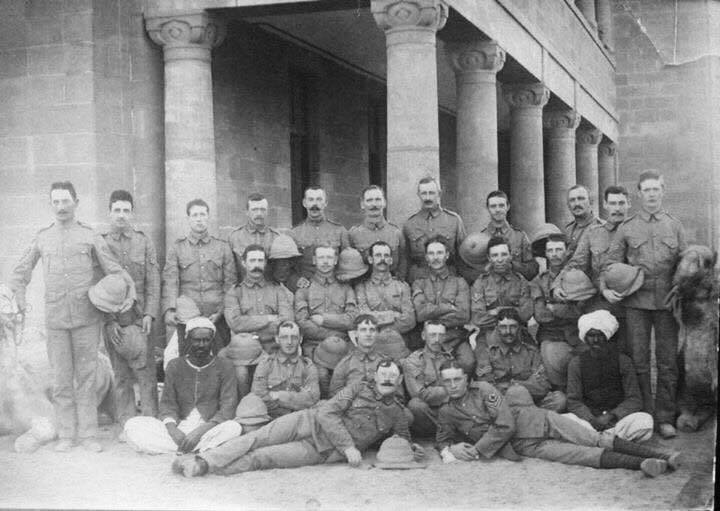
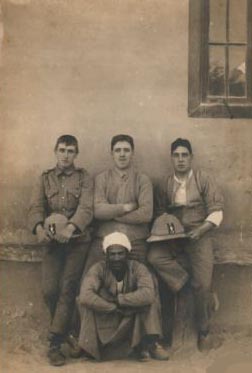
Memorial at Ypres, Belgium. Photo is of the Middleton Territorials
at Egypt prior to going to Gallipoli. |
|
Died on 04/07/1915
Private John Whitworth 1/6th Lancashire Fusiliers Private John Whitworth of the
6th Battalion Lancashire Fusiliers, whose home address was Factory Street,
Middleton, died on July 4th, 1915 from wounds received in action at
the Dardanelles on May 5th. May 5th was the day the 1/6th
were in action for the first time at Gallipoli, known as the 'Second
Battle of Krithia' Netley Military Cemetery is a permanent military cemetery, the property of the Ministry of Defence. The cemetery was at the back of the Royal Victoria Military Hospital and was used during both wars for burials from the hospital. The cemetery contains 636 First World War burials. |
|
Died on 05/06/1915
Private Herbert Turles Two Middleton Territorials were killed on this day during 'The Third Battle of Krithia' Another son of Middleton to lay down his life in the Dardanelles was Private Edwin Broxton, son of Mrs. Broxton, Hanson Street, Middleton. He was one of the famous 6th Battalion Lancashire Fusiliers who fought at the Dardanelles, and he was killed on June 5th, 1915. Broxton who was 19 years of age, joined the Territorials in 1913. He was employed as a piecer at the Albany Mill. Private Herbert Turles, of the Lancashire Fusiliers, son of Mr. and Mrs. Turles, Boardman Lane, Rhodes, was killed on June 5th, 1915. Turles, who was employed by the Heaton Mills Bleaching Company, joined the army in 1914. He was a member of the Little Heaton Social Club. Unfortunately both soldiers have no known grave, so their names are on the Helles Memorial at Gallipoli. |
|
Died on 04/06/1915
Private Frank Connolly Private Thomas Connolly Lance Corporal Robert Graham Private Fred Gordon 1/6th Lancashire Fusiliers. 4th June 1915, the local Territorials, the 1/6th Lancashire Fusiliers, were in action this day, in a battle that is known as 'The Third Battle of Krithia' at Gallipoli. Among the dead were two brothers
19-year-old Private Frank Connolly and 26-year-old Thomas, both of Sadler
Street, and who had joined up together at the start of the war. Another
brother James had been invalided home sometime before after serving
in France while a fourth brother had died in a tram accident in Middleton
four years earlier. Both brothers as well as Private Gordon and Lance Corporal Graham have no known graves, their names being on the Helles Memorial. |
|
Died on 02/05/1918
Sergeant James Keefe Labour Battalion, formerly of the 6th Lancashire Fusiliers. Sergeant James Keefe, of the Labour Battalion, who resided at 27, Old Hall Street, Middleton, died on May 2nd, 1918. The late soldier was 50 years of age, but enlisted right away at the outbreak of war and was posted to the Lancashire Fusiliers. He was afterwards transferred to the Labour Battalion, and contracted a severe cold which culminated in pneumonia during leave. When a young man he was in the Royal Field Artillery for throughout the Boer War. At the time of joining up he was employed in the colour shop at the Rhodes Works. He was connected with St Peter's Church, and was captain of the Boys Brigade. A very impressive funeral was conducted by the Rev Father Hanrahan. Sergeant Keefe is laid to rest at Boarshaw Cemetery, Middleton. His son, Private James Keefe also fought with the 1/6th Lancashire Fusiliers at Gallipoli. |
|
In Memoriam
Died one hundred years ago March 21st 1918. Private George Allinson Private Thomas Steeple, aged
36, of the 1/6th Lancashire Fusiliers, who resided at Boarshaw Road,
Middleton, was killed in the 1918 fighting. This soldier, who was employed
by R.K. Lee and Co., enlisted on September 6th, 1914. Private Steeple has no known resting place, his name is on the Pozieres Memorial, France. A lot of Middleton casualties
today as |
|
Died on 12/08/1915
Private Thomas Ratcliffe 1/6th Lancashire Fusiliers Private Thomas Ratcliffe of
the 1/6th Battalion Lancashire Fusiliers, made the great sacrifice at
the Dardanelles on August 12th, 1915. Another Middleton Territorial
today, Private Ratcliffe is laid to rest at the Redoubt Cemetery at
Gallipoli. |
|
Died on 06/09/1917
A very sad day in the history
of Middleton, now largely forgotten, this should be on every local school
curriculum or commemorated somewhere at least. The men from Middleton killed that day. Private Ernest Ashton 125 Brigade, consisting of the 1/5th and 1/6th Lancashire Fusiliers, with the 1/7th and 1/8th in support, attacked the positions known as Iberian, Borry and Beck House Farms. Starting at 7.30 a.m. a company of the 1/6 managed to take Beck House but the two companies attacking Iberian Farm came under machine-gun fire from the southern slopes of Hill 35. At 10.45 a.m. the Germans launched a bombing counter-attack which re-took Beck House, killing or capturing all but two of the Fusiliers. This in turn exposed the other companies to fire from Hill 35 and forced them to withdraw to their original positions. Private Harry Nugent, of the
Lancashire Fusiliers, whose home address was 5, Heaton Street Rhodes,
was killed in action on September 6th, 1917. This young soldier was
only 20 years of age, and joined the Army in June 1916. Private Nugent is commemorated on the Tyne Cot Memorial, Belgium. |
Click on the cutting to enlarge
|
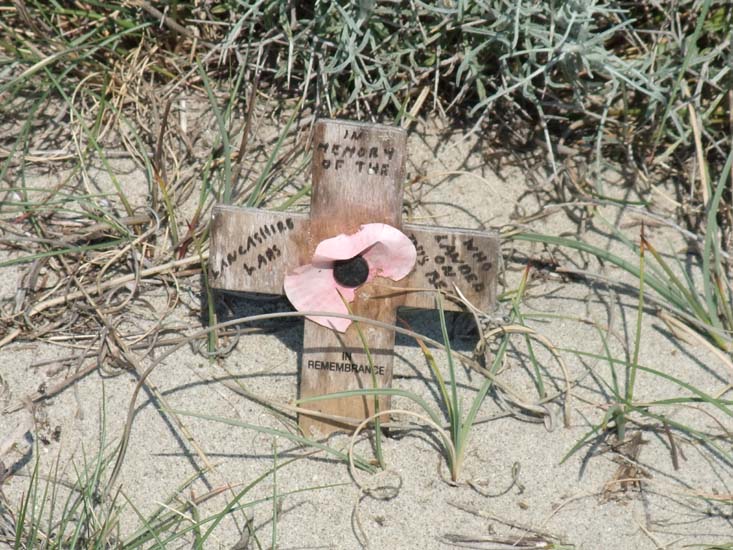
The photos of a home made plaque
dedicated to the Fusiliers.
|
|
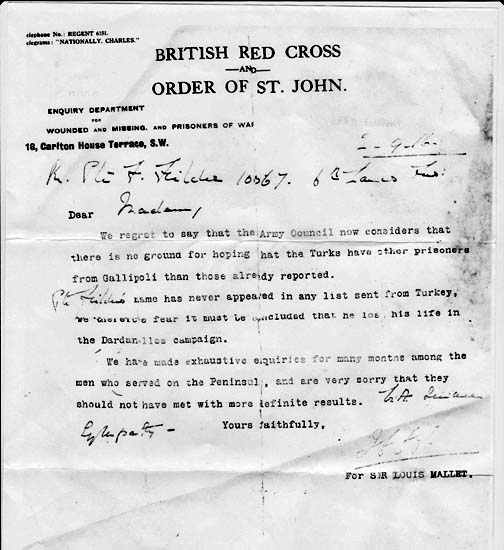
Fred Fielder was KIA at Gallipoli, he was
the grandfather of Graham Tattersall Date of Death: 07/08/1915 Regiment/Service: Lancashire Fusiliers 1st/6th Bn. Panel Reference Panel 58 to 72 or 218 to 219. Memorial HELLES MEMORIAL |
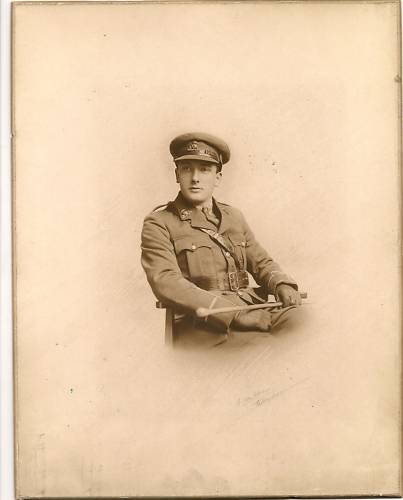 2nd Lt P S Sutcliffe |
 |
|
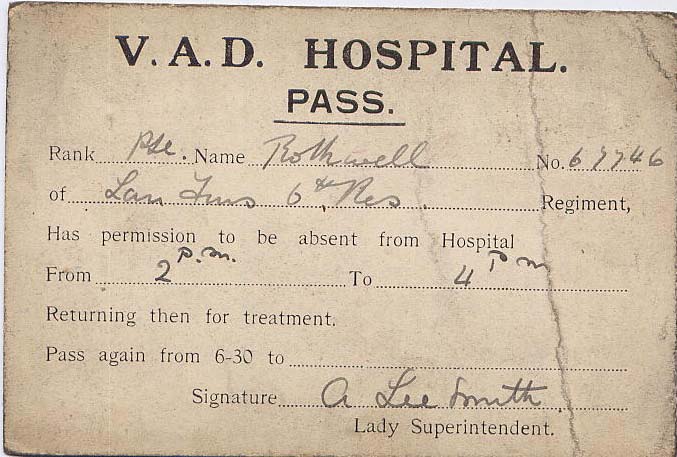
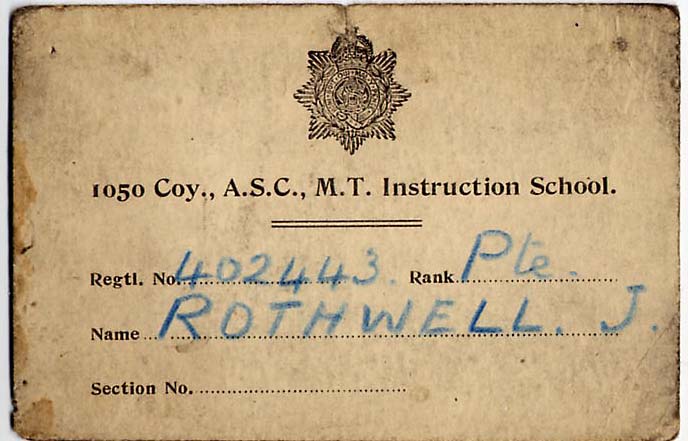
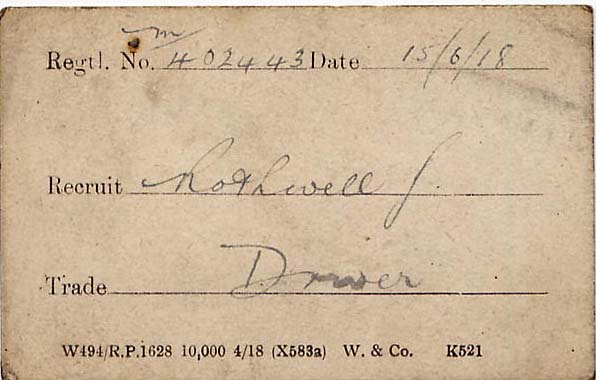
Pte J Rothwell
18 years old Pte J Rothwell was spared the horrors of WW1 by contracting the Flu in 1918 when training at Bridlington. He recovered in the Voluntay Aid Detachment hospital Bridlington and was then sent for training as a driver to 1050 Company Army Service Corp.
|
|
Letters home from Gallipoli
sent in by David Platt
|
|
8432 Lcpl Harry
Wrigley
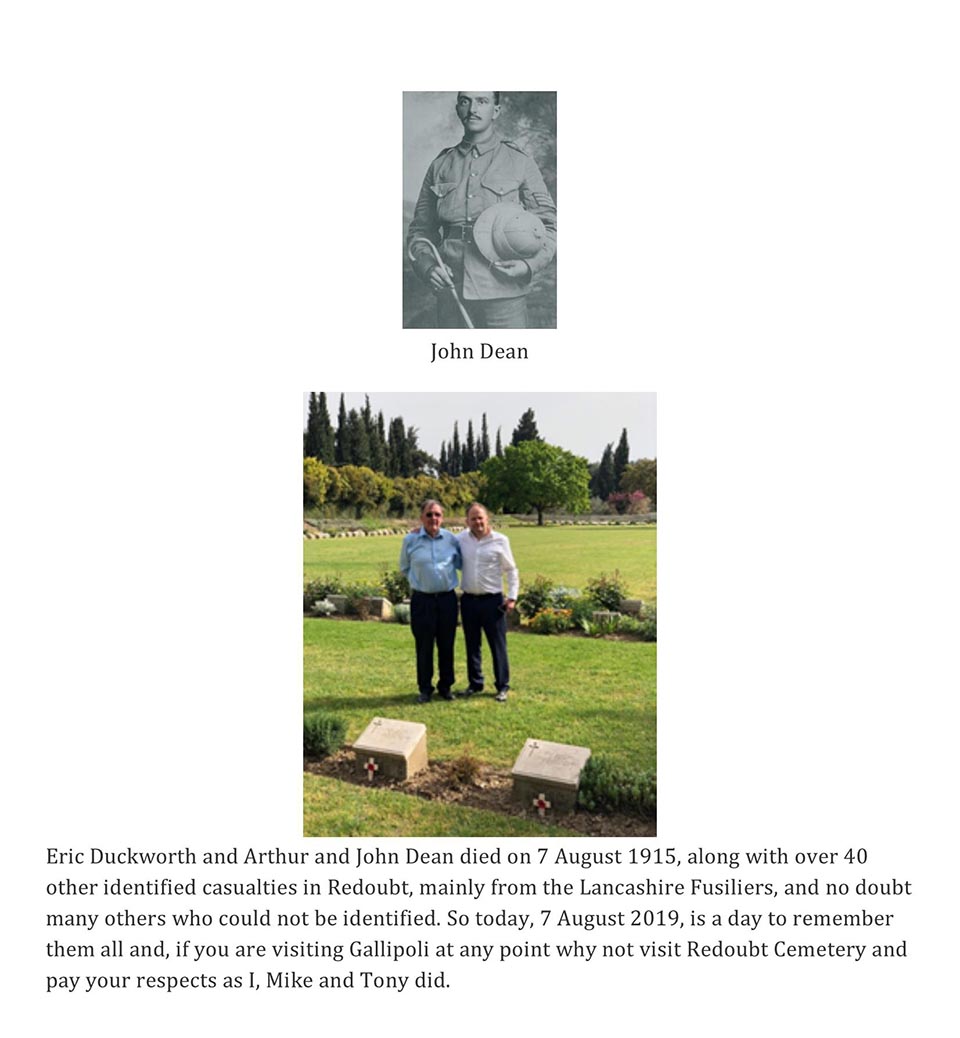
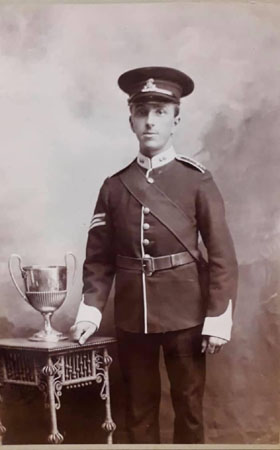
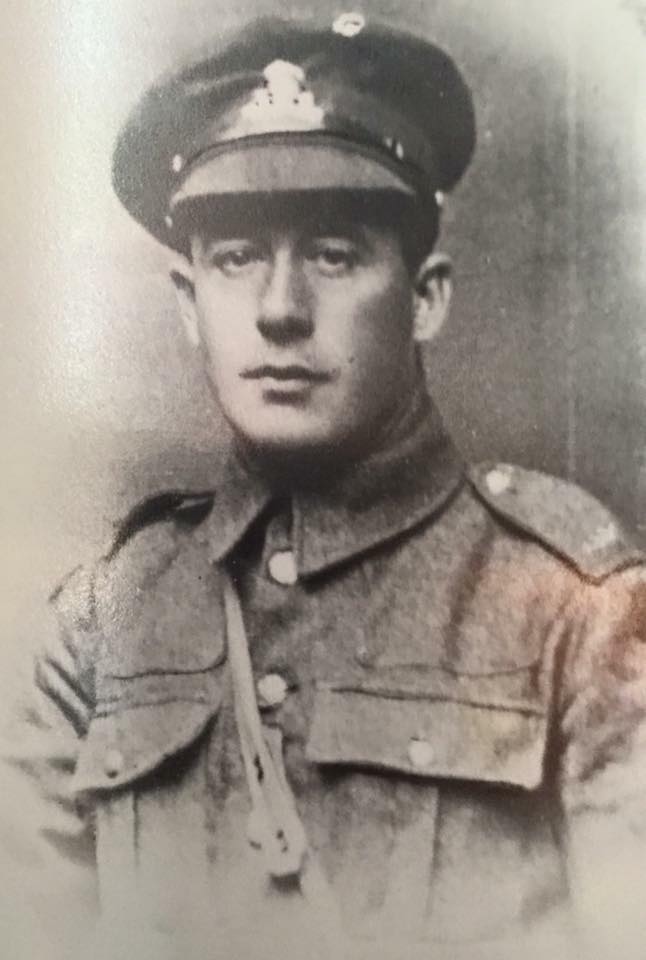
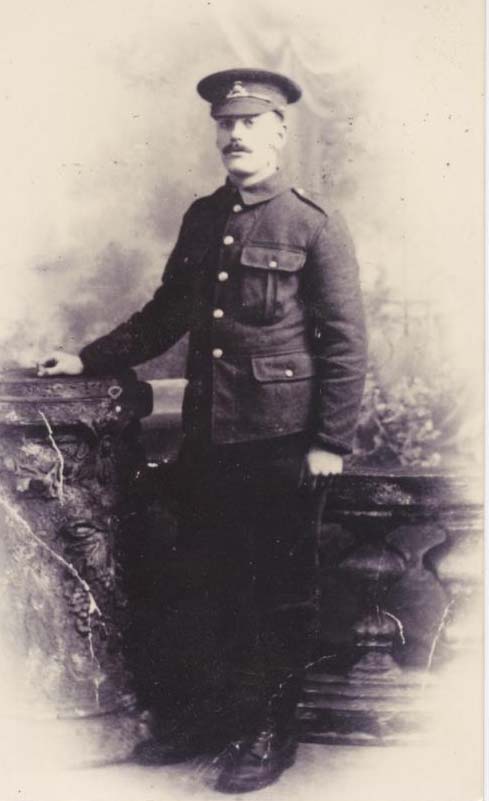
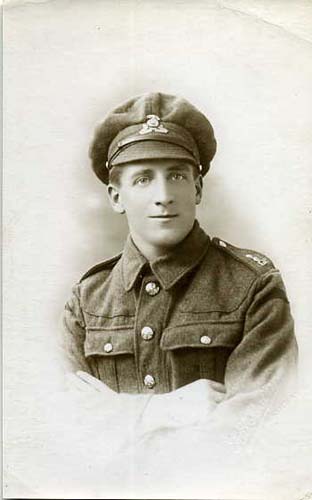
1/6th Lancashire Fusiliers Born Shaw [Oldham Lancashire] 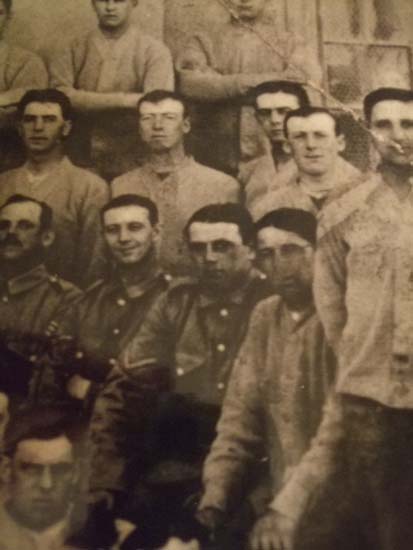 My grandfather is the Lpl in the photo this was taken before they went to Gallipoli Enlisted 28th feb 1911 Aged 17 years 7 months Served B company No 15 section Landed Gallipoli 5th may 1915 Discharged permanent class B Feb 1916 Enlisted Royal Artillery as Gnr 1916 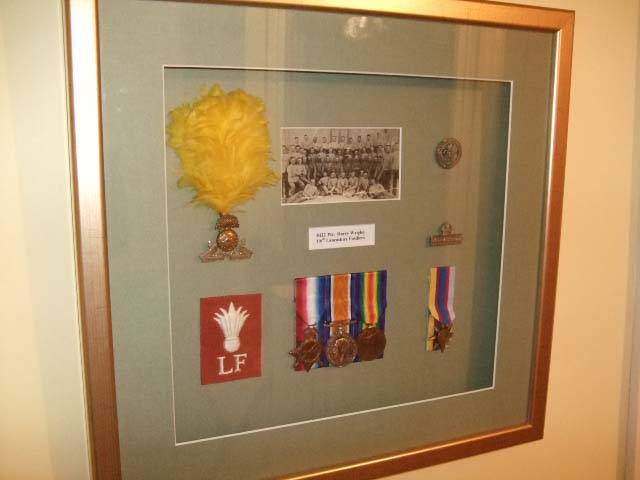 sent in by Mark Wrigley Harry's grandson
|
|
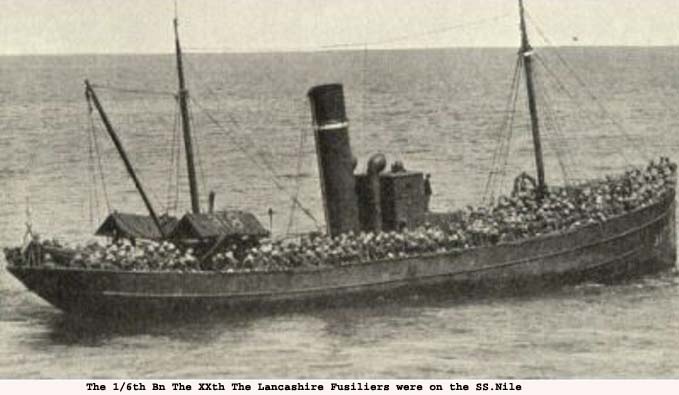
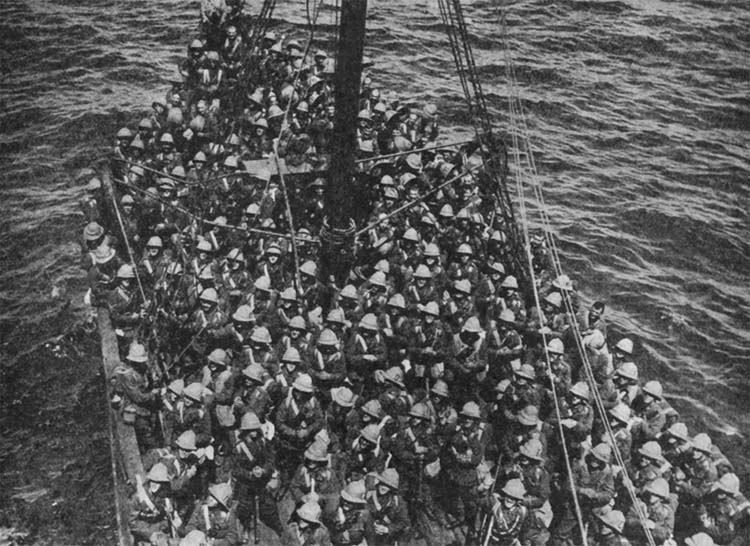
The SS Nile
on Route to Gallipoli
The 1/6th Bn The XXth The Lancashire Fusiliers were on the SS.Nile The 1/6th Lancashire Fusiliers
of the 125th Brigade,The East Lancashire Division began to embark at
Alexandria on 1 May 1915. |
| This
is one of Danny Daniel's Grandfather.
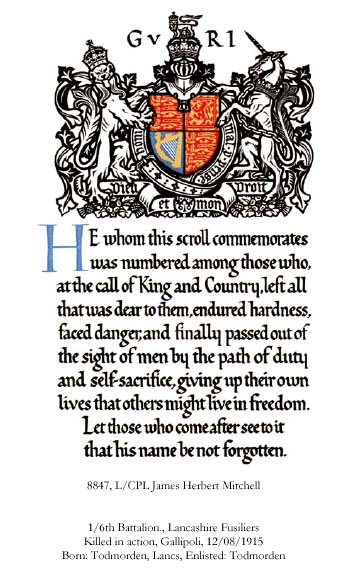
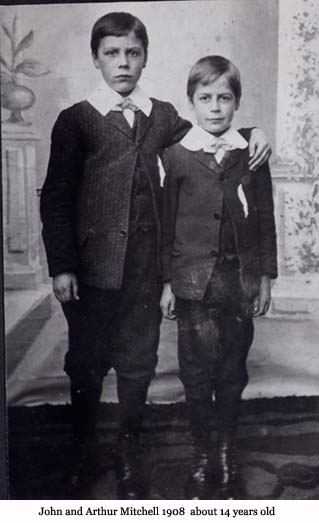
The photos shows J.H.Mitchell on the left of the photo,the photo was taken in 1908, he would have been about 13 or 14 years old.The scroll was sent to the family who apparently would never believe he was dead. He would have left Egypt between the dates May 1st and May 6th 1915, going by the date of his death I would presume he was killed at the battle of Krithia. Vineyard grave number G54 Lancashire Landing Cemetary
|
|
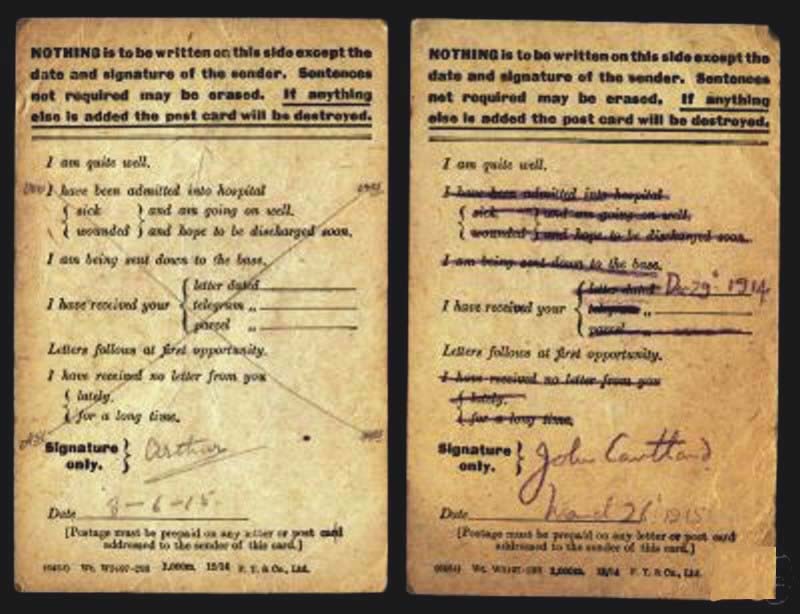
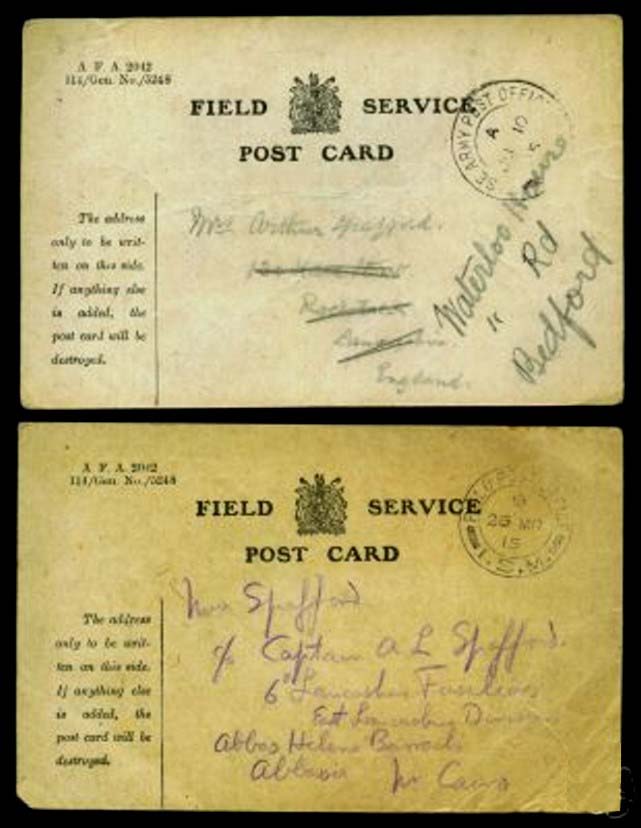
Letters and postcards of
More to follow on this story |
|
Private David Smethurst
1/6th Lancashire Fusiliers Private David Smethurst of the
Lancashire Fusiliers, who was taken prisoner on February 12th, 1916, died
on January 13th, 1917, at Angora, Asia Minor, from typhus. I'm not too sure on his date
of him being captured, he was probably took as a prisoner at Gallipoli
in 1915.
|
|
A
SELECTION OF TODMORDEN MEN WHO SERVED |
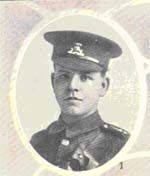 Private John W. Child, D.C.M. 1st/6th. Battalion Lancashire Fusiliers He was awarded the D.C.M. for gallant conduct on 4th June 1915 south of Krithia, (Dardanelles) Gallipoli, for volunteering to attack a redoubt, and holding it with 4 other men until relieved ten hours later. He had previously been mentioned for gallantry. Private Child died from his wounds on 4th August 1915, shortly after having earned his distinction. His medal was presented to his father in the Town Hall, Todmorden, on 30th November 1915. |
|
Company Sgt. Major
Bradshaw Allister D.C.M.
|
|
Sergeant Taylor has no known
grave. He is remembered at Loos Memorial, Pas de Calais, France, |
| Sergeant
Alfred Hamer, D.C.M. 1st/6th. Battalion Lancashire Fusiliers He had been twice previously commended for gallantry and was awarded his medal for conspicuous gallantry on 6th. May 1915 on the Gallipoli Peninsula, when he led a half platoon during the attack with great ability and courage. On several occasions he carried messages under heavy fire. |
|
Private Richard Allen,
D.C.M.
1st/6th Battalion Lancashire Fusiliers He received his medal for gallantry while on sentry duty at an advanced post south of Krithia on June 4 th 1915, noticing movements in the scrub, and boldly going into it on his own initiative under heavy fire. He found a Turkish machine gun with an officer. He took the revolver from the officer and brought in the machine gun. He was presented with his medal at Todmorden Town Hall on 30th November 1915. |
| Private
F. Hewson, D.C.M. Lancashire Fusiliers He received his Distinguished Conduct Medal for setting a fine example to all ranks of initiative, leadership, and fighting spirit during an attack east of Serre on 21st. March 1918. |
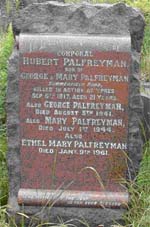 Corporal Hubert Palfreyman 1st/6th. Battalion Lancashire Fusiliers Corporal Palfreyman died at the age of 21 during the Battle of Ypres. His body was never found. He is remembered at the Tyne Cot Memorial in Belgium, which bears the names of almost 35,000 officers and men whose graves are not known, and is one of 4 memorials to the missing in Flanders. Hubert is also remembered on his family gravestone at St. Paul's Cross Stone. In Loving memory of Corporal Hubert Palfreyman son of George and Mary Palfreyman of Summerfield Road. Killed in action at Ypres September 6th 1917 aged 21 years. |
Gallipoli:
'We will keep the flags flying' Martin Purdy and Ian Dawson 26/ 5/2005
"One thing that has always stuck in my mind was during the First World War. As a boy I saw a postman sitting on the kerb at the top of Cheapside, crying and sobbing like a child and wiping his tears away with a big red and white handkerchief. He had been delivering war office (death) telegrams to nearby cottages. "As he cried the women in their houses were screaming, except one white-faced, shawled and clogged old lady who sat on the flags next to the postman and simply held his hand." What the late John Bagot describes so vividly is the news returning to the town of the catastrophic local losses at Gallipoli in 1915. As reported last week, around 250 Middleton territorials had volunteered for service overseas at the outbreak of WW1. They became part of the 1/6th Lancashire Fusiliers battalion and we pick up their story as they enter the maelstrom of the campaign to defeat the Turks on the small peninsula of the Dardanelles called Gallipoli. The disaster of the campaign has been well documented over the years, not least by the Australians. Their sacrifices, fighting for the first time under their own colours, resulted in a huge step towards the establishment of Australia's own national identity and international recognition. However, the fact is often overlooked that the British and French were just as deeply committed. We suffered 65,000 dead and wounded, the French 27,000 and the Australians 26,000. The invasion of Gallipoli was planned after the Turks entered the war on the side of the Germans in late 1914. If the straights of the Dardanelles were conquered, we could have warships in Constantinople in days and deliver a quick and resounding blow to the Turks, while also opening another vital link with our Russian allies via the Black Sea. In principle, the idea (in which Winston Churchill, then at the Admiralty, was a major player) was sound. In practice, things went wrong from the start. It had initially been hoped that the navy could deal with the clearing of the straights themselves and sail victoriously into Constantinople. They would bombard resistance at the gateway to this narrow sea waterway (Gallipoli) and surge through. However, brave resistance and mines foiled the scheme and a call was made for a land force to deal with the Turkish troops fighting so tenaciously. On April 25, 1915, 30,000 allied soldiers would be landed on Gallipoli, but many never even reached the beach. A regular, or professional, battalion of The Lancashire Fusiliers was dropped in the shallows only to run into belts of barbed wire laid below the waterline. While trapped on the wire, they were slaughtered by machine gun fire from the cliffs surrounding the bay. The battalion was to win six Victoria Crosses "before breakfast" in successfully fighting for control of the beach head. Among these professional soldiers were a number of Middleton men who survived the landing, but the likes of Private Herbert Simpson, of Mills Hill Road, and Lance Corporal John William Horrocks were to pay the ultimate sacrifice later in the campaign Despite some early signs of promise, and a number of lost opportunities, the situation on Gallipoli soon came to mirror the stalemate on the Western Front - men sat in trenches just a few dozen yards apart and mounting costly attack and counter-attack against heavily defended positions. The only hope now was that sheer volume of numbers might tip the balance; and so it was that the 42nd East Lancashire Division, including the Middleton Territorials, found themselves moved from Cairo and rowed ashore in the evening of May 5. Unlike their professional compatriots, the landing of the Lancashire territorials passed without incident. But their good fortune wasn't to last, as the Middletonians found themselves rushed into front-line trenches and going "over the top" within less than 24 hours. "In the morning, about 11 o'Clock, we made an attack across open country but we were swept down by heavy machine gun fire and we lost heavily," writes Private Walter Hosker to his father at Pool Bank Street, Rhodes. Corporal William Aspden, another Middleton man, who worked on the trams at home, writes to his wife: "By gum, it was like hell. Bullets were whistling all around me and shells were bursting. It was murder. Our officers are a credit to England." The 1/6th Lancashire Fusiliers (made up of the Middleton lads and fellow part-time soldiers from Rochdale and Todmorden) gained 400 yards of ground; the greatest advance made by any unit that day. More importantly, the ground was held. Still, it had proved costly and four Middletonians were among the dead, with many more wounded. Among the fatalities were Percy Beaman, a 21-year-old parishioner of All Saints Church who lived at Rhodes, and Sergeant James Burgess of Middleton Junction, who worked at JW Lees Brewery. Around 50 more local lads were to follow in their footsteps before the year was out, and a large number of them were to be killed just weeks later, on June 4, attacking the same objective as this first bloody charge - the small village of Krithia. Krithia was an important strategic objective that lay just below the commanding heights of Gallipoli. From there you could see what was going on on most of the peninsula. This time the Middleton men would have to charge across about 100 yards of open land through artillery and machine gun fire and into belts of barbed wire. It was carnage and 10 local men were to die, including the Connolly brothers - Frank was aged just 19 and Thomas was 26. They lived in Sadler Street with their parents and siblings. Private Walter Hosker picks up the story of the attack: "We captured and killed some thousands in a bayonet charge. At night the Turks tried to retake this trench and came up in droves with fixed bayonets shouting 'Allah, Allah'. We fixed our bayonets and jumped out of the trench and charged." Sergeant James Dean, of Wood Street, Middleton, adds: "We had a terrible time. We made a general advance and took some of their trenches and our battalion was in the thick of it from start to finish. How I got through safely I do not know." Tragically, the married 30-year-old was to die just two months later. His 23-year-old brother Arthur, who lived at the family home on Grimshaw Lane, was killed on the same day. The brothers now rest side-by-side in Redoubt Cemetery, Gallipoli. The Dean brothers were among 22 more local men killed repulsing a ferocious Turkish attack in August on a position called, for obvious reasons, The Vineyard. Now it was personal, and far from being disheartened Sergeant Ruckman, another Middletonian writing to a friend at Wood Street, sums up the feeling... "Some of the lads call us 'The Fighting Sixth'. We are getting quite used to our little hole in the ground, but it is awful out here and no matter where we are we are under shellfire. "All
the lads are going hunchbacked with ducking, but we are getting used to it and
the boys are game. If Middleton will keep the homes going, we will keep the flags
flying and keep the fighting name." |