
|
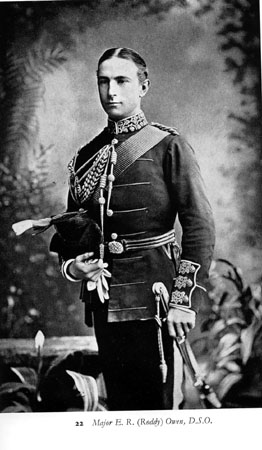
Major E R
(Roddy) Owen DSO
The XXth The Lancashire Fusiliers. |
 |
 |
 |
 |
 |
 |
 |
|
RODDY OWEN DSO
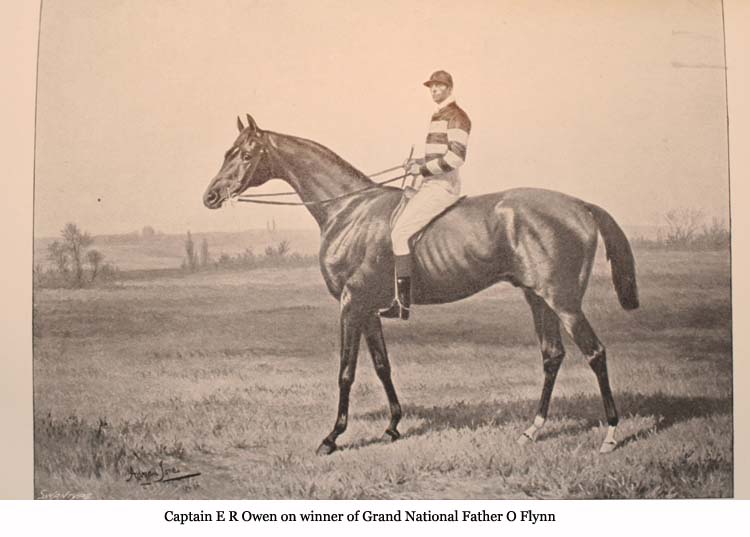
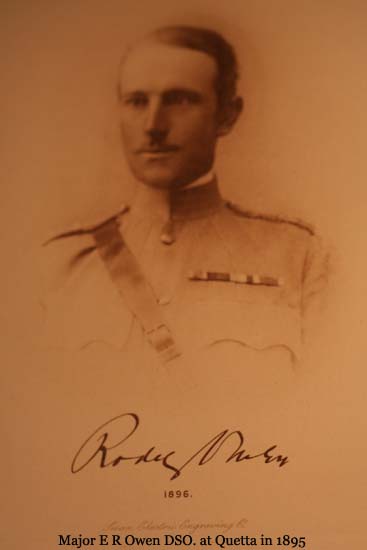
The Regiment and the county of Lancashire got to know each other particularly well in the winter of 1798-99, when the Twentieth had great success in raising recruits in Preston. (Recruits had been raised there before, and the Regiment had marched through the county on its way to Culloden.) Although it was known at this time as the East Devonshire Regiment, it began to rely more and more on getting its ranks filled from Lancashire, so that when, in 1881, the Report of the Ellice Committee on Formation of Territorial Regiments recommended the extensive re-allocation of Line regiments to counties, a long established connection was openly recognised in naming the Regiment the Lancashire Fusiliers.(Editors note:- it should be pointed out here that the story of the Regiment not being granted the "Royal" in their official title due to some misdemeanor is a myth!-Joe.) Another firm connection with Lancashire was already in being, for the Regimental Depot had been moved from Exeter to Wellington Barracks, Bury, in 1873, and those familiar buildings, which dated originally from 1845, with many later additions, were to become well known indeed to all the succeeding generations of Fusiliers. It remained the Regimental Depot until 1961, when the final parade was held there on March 17: it is still the Regimental Headquarters(Lancashire), and houses the Regimental Museum. Apart from the changes affecting the Regiment, there had been many important innovations in the Army as a whole since the mismanagement of the Crimean War had revealed the faults of the old system, and the growing military power of Prussia began to alter the military balance of Europe. Cardwell's reforms were carried out between 1868 and 1873, and included the abolition of purchase by officers of commissions and steps in rank.(Not before time !! But it would still be many many years before "working class" applicants would be able to gain commissions-Joe-Editor) Among the other changes was the introduction of a trained reserve, which had to depend on a short-service army. Cardwell introduced enlistment for six years with the colours, followed by six years in the reserve, and he also assisted recruiting by abolishing flogging in peace time. Another equally important step was to develop recruiting grounds and to connect the regular Army with the militia by making it territorial in its regimental title, assigning to each historic numbered infantry regiment a local depot and a county name. The Twentieth already had its second battalion, but it was made the rule that all regiments should have two linked battalions-one of which would be on foreign service-associated with its county militia and volunteers. Although the name of the Regiment changed, a link with the West Country still remained. A handsome memorial in Exeter Cathedral recalls those members of the Regiment who fell in the Crimea. The old Twentieth had to a large extent been officered by men from West Country families and this link remained for some time. (Other ranks had long been recruited mainly in Lancashire.) The abolition of purchase did not show its full effects for some time and as the pay of an officer was not very great, it was still necessary for an officer to have some private means especially if he was to get married. It was unusual for an officer to marry young and, therefore, he was able to devote more of his time to regimental activities and to becoming imbued with the regimental spirit. For a young officer fond of sport and with the gift of friendship, life could be very pleasant in an infantry regiment in the second half of the last century. Whether his battalion was stationed in India, Ireland or at home, there was always plenty of racing, shooting and dancing. The Regiment had a reputation for its excellent cellars: s of Professor Saintsbury's scholarly wine-bibbing was done with an officer of The Twentieth.* Ilow one could make the most of this kind of life is exemplified in the short, brilliant career of Roddy Owen, one of the 'characters' that the British regimental system used to be able to accommodate and even encourage-to the advantage of the system, and the Army as a whole. A brilliant horseman and a good shot, Roddy Owen's courage went without saying, but at the time of his death the quality of leadership that went with it was also being revealed; his high sense of honour and duty found its expression through a most original turn of mind. He was a man of whom the Lancashire Fusiliers have always been proud. * The late Maurice Healy, in his Stay Me Wit! Flagon (1941), recalled
a 1923 Les Musigny he had drunk in the 1st Battalion mess that was,
'all that good burgundy should be; and it lost nothing by being drunk
in such excellent and hospitable company'. He also wondered, in a
later chapter on beer, whether Lancashire ales had helped 'to make
the Lancashire Fusiliers what they arc: and what highs, praise could
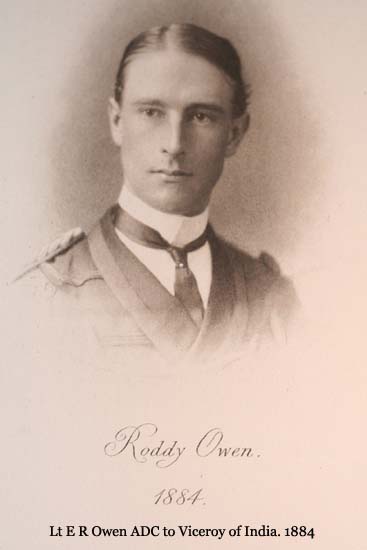
be given?' While out on training as A.D.C. to General Sir Evelyn Wood** at Aldershot, Roddy's horse ran away with him, or so he said on return in apologetic explanation to the general: `Would you believe it, sir, I never got a pull at him for miles l' He omitted to mention having picked up racing-kit from his servant at the station, taken a train to a nearby meeting, and ridden a race. When this account was given to me by an old member of my regiment and a contemporary of Roddy's, I had asked if he got away with it. 'Oh, yes', was the reply. `He could talk his way in or out of anything.' My informant went on with a story of Roddy at Quetta: `The whole garrison was away on a field day, Roddy being stuck in barracks as Captain of the Week. Bored with nothing to do, he rode out to us. Seeing the troops lying down in position ready for the final assault, he galloped up waving his sword and yelling, " Charge! "-which we all promptly did, delighted to get the whole thing over so quickly.' Roddy, of course, didn't wait for the trouble to come, and you can imagine how damned angry the general was. Major Owen would get no leave for a very long time and so on. Now comes the surprising bit. Roddy, on being told of this while dressing for dinner, immediately ordered his horse, saying, `We'll see about that', and went off to the general. On return he announced his departure on leave. We never heard what transpired. Roddy wouldn't say a word about anything like that. * April 1961, **Later Field-Marshal. THE LANCASHIRE CONNECTION Many similar stories of this part of Roddy Owen's life are told;
his sister, Mrs. Bovill, and G. R. Askwith, published the one that
follows in a memoir after his death: And so the nation and the regiment lost a unique and supremely
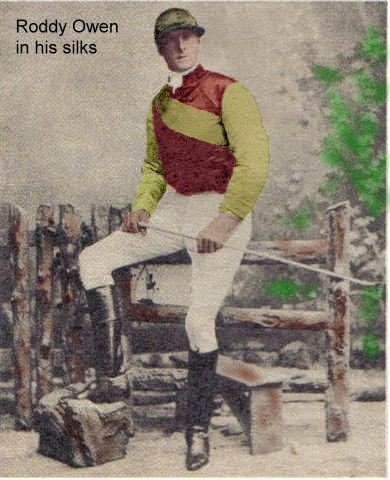
different soldier. Joe Eastwood. Brevet-Major Edward Roderic OWEN, DSO - Lancashire Fusiliers (Attached Egyptian Army) - died at Ambigol, 11th July 1896, commanding a Sudanese Irregular corps. Born 4th May 1856 at Prestbury, Gloucestershire. Son of Hugh Owen. A talented jockey, he rode 'Father O'Flynn' to victory in the 1892 Liverpool Grand National horse race. Served in West Africa 1892 (wounded, DSO, MID, medal & clasp, Brilliant Star of Zanzibar). Commandant Equatorial Provinces of Torn and Unyoro 1893-4. As Commandant of Ambigol Wells he died of cholera. Michael Murray |
|
Roddy Owen NOT so long ago a distinguished retired general, who in his own
words |
| In May 1891 the British Acting Governor, Captain C.M. Denton C.M.G.,
left Lagos with an escort of Hausa constables (Hausas are from the Islamic
north of Nigeria) to visit Jebu Ode to make agreements allowing the free
passage of trade goods through Ijebu territory. However the Awujale refused
to agree to the British requests and he also rejected the British presents
given to him by Denton, doubtless fearing that to accept them would obligate
him in some way.
London then instructed Lagos to obtain an apology from the Awujale for the perceived "insult" to Denton, and to insist on free right of way through the Awujale's territory. In January 1892 a representative of the Awujale went to Lagos to agree to the British demands, and in return the British granted the Ijebu 500 pounds annually to compensate for the loss of customs revenue. However the tribe was unhappy with this outcome as it did not wish to change its traditional methods and practices, particularly when threatened by foreigners. A white missionary was allowed through Jebu territory but the second one who tried received a rough time and was sent back, as was a party of Ibadan porters attempting to come south through Jebu Ode. London now authorized the use of force, quickly sending out some special service officers from England to act as a military staff. One of these was Captain Edward Roderick ("Roddy") Owen of the Lancashire Fusiliers, a famous jockey at British race meetings. |