|
The Feature Page |
|
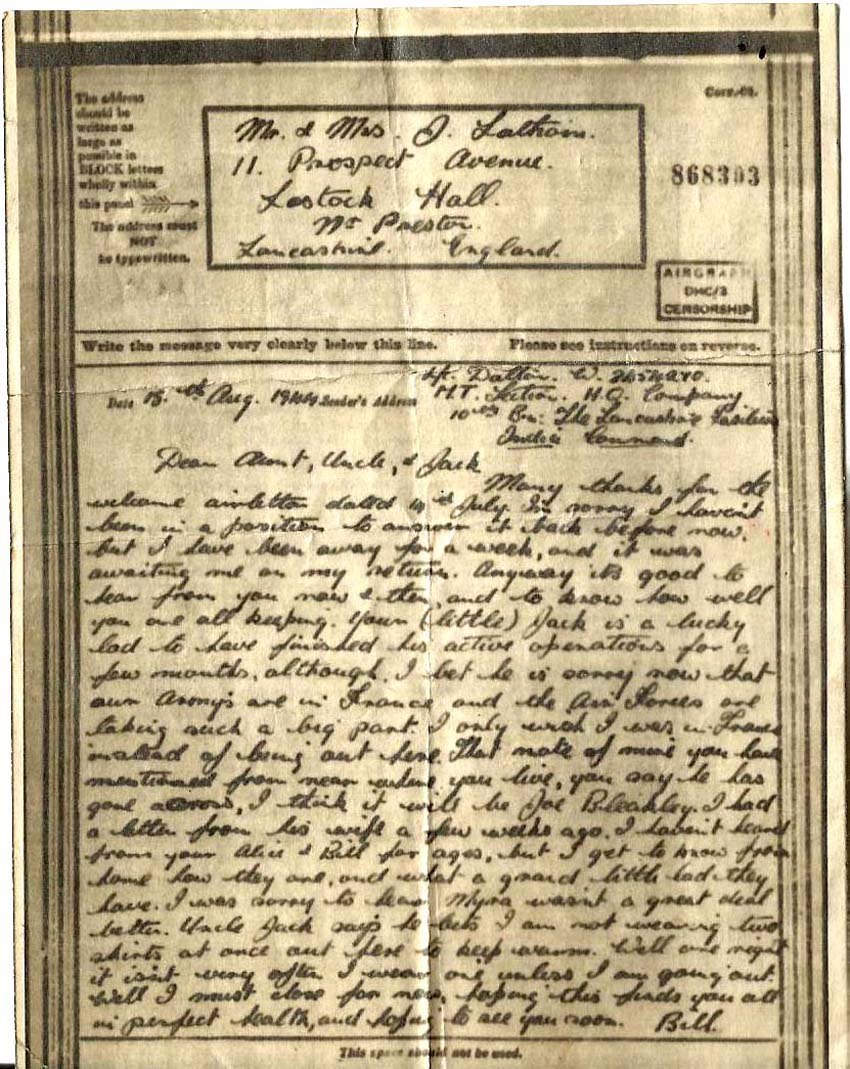
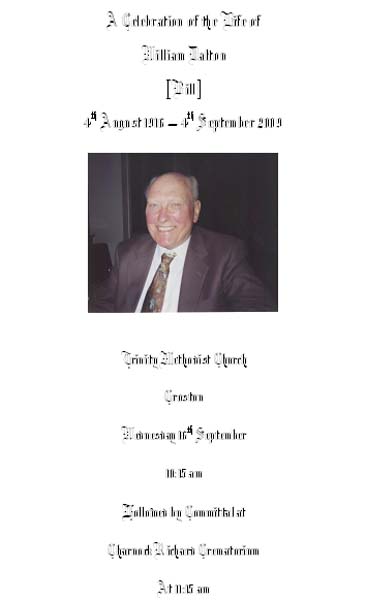
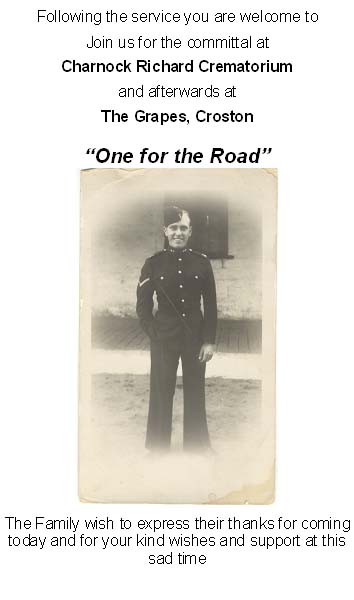
WILLIAM (Bill)
DALTON'S FUNERAL
16TH SEPTEMBER 2009
Click on any of the above
to enlarge
|
Click
Here The day Bill was shot, narrated by Cyril Robinson
|
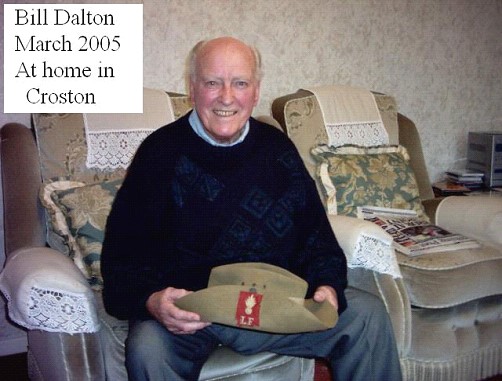
William (Bill) Dalton was born
on the 4th August, 1916 in the Village of Croston near Chorley, Lancashire.
He was the only son born to Jethro and Grace Dalton (nee Catterall). Bill
had three sisters, one of whom survives to this day and has attained the
grand age of 92 years.
Bill still lives in Croston Village, not a stones throw from the house in which he was born. His son John lives nearby and his daughter Audrey visits frequently. Bill had an uneventful, happy 'normal 'childhood and after leaving school was apprenticed as a Painter and Decorator. In March 1940, along with thousands
of other young Lancastrians, his life was changed forever when "Duty
Called", and he was conscripted into the Army for War Service. Matters had moved very swiftly prior to his arrival at Wellington Barracks. Only the previous Saturday he had presented himself at Croston Post Office in answer to the Conscription Notice (a Military Administration necessity at that time), and at the beginning of the following week he attended at Pole Street, Preston for his compulsory Medical Examination. Having been found to be 'fit in wind and limb' and having had his testicles weighed with the obligatory cough, he was declared fit for Military Service. Along with numerous other young
men who had attended their Thus began approximately three months of rigorous Basic Training, the format and undoubted pleasure of which will be instantly recalled by all former soldiers. During his first week of training Bill was to receive his first (and perhaps not last) Army 'b***cking' from non other than the Depot's Commanding Officer at that time Lieutenant Colonel. Slingsby. (CO) Bill was heading for the dining halls and had his 'side cap' stuffed under his epaulette, and was carrying his knife, fork and spoon in his right hand. (all former soldiers will know these items as simply K.F.S!).
Nor do you give the CO a threesome K.F.S. salute with the right hand! Bill was 'spoken to' by the CO and asked how long he had been in the army. Bill rather sheepishly replied "only a week Sir!!" Lt. Col. Slingsby clearly took pity on Bill and 'offered' him appropriate advice. It must have been good, Bill can recall the incident 65 years later as though it was yesterday! Another story of that time is perhaps a good reflection of how discipline was enforced and how it was possible to very quickly fall 'foul'. Daily Orders always stated the 'dress of the day' i.e. working dress, shirt sleeve order, buttons done up or open neck etc. and the 'dress code' was also applicable to troops leaving barracks for the occasional night out. One Saturday afternoon, Bill had obtained a pass to leave barracks and in accordance with the dress of the day wore his greatcoat with buttons 'fastened'. On leaving Wellington Barracks, he entered the Guardroom where he was required to produce his pass. Whilst doing so the Guard Commander leant over his desk and pointed out that Bill had not fastened the bottom button on his greatcoat. Needless to say Bill was ordered back to his billet and never had his night out in Bury!! At the conclusion of Basic Training (approximately late May 1940), Bill was given the choice of joining one of three specialist units. This was not perhaps as glamorous as it may sound! The choice was one of the following: Motorised Transport (MT) Section Bill who was already a qualified driver and a keen motor-cyclist chose the MT Section. He was therefore posted to the Depot's Motorised Transport (MT) Section, which at that time was based at Lower-Croft Mills near the Village of Walshaw (about 3 miles from Wellington Barracks). Although part of the 'Mills'
are still intact, the area of the Lower-Croft Billets just north of the
Lower-Croft Mills Depot, now form part of a large housing development.
(See Bill's Gallery
- photo taken outside the 'Wooden Huts' at Lower-Croft Billet)
As a qualified driver on both four and two wheels, Bill later found him self assigned to Driving Instruction Duties and spent numerous hours teaching Army recruits how to drive. It is a fact that in the late 1930's early 40's the ability to drive was not common and Bill's "teaching skills" were in great demand. Bill tells a truly sad but heartwarming tale of the "knock-on" effects of the war during those early dark days of 1940, whilst based at Lower-Croft Mills. On the 4th June, 1940, the German Army seized the Port of Dunkirk, and in the days prior to and thereafter, members of the British Expeditionary Force (BEF) began arriving back on the UK mainland. The returning troops, many in sheer desperate state were subsequently billeted throughout the United Kingdom. Such was the scale of the Evacuation and administrative turmoil that followed (with due regard to the monumental and sterling efforts made by many individuals both Military and Civilian, as readers will be only too well aware), quite a number of the evacuated BEF troops found themselves in the Bury area. In the true spirit of Lancastrians everywhere, Bill and his fellow Fusiliers based at Lower-Croft Mills actually gave up their billets and blankets in favour of the returning troops, and spent several nights sleeping in the fields adjacent to the camp. Bill says that no orders were necessary, it was just done. It would suffice to say that the needs of the many outweighed the needs of the few! At about this time Bill was assigned as a temporary driver to a Major Crawford, who was overseeing training (and living on) at the Holcombe Moor Training Camp. Major Crawford's regular driver had gone on leave (as it turned out much to the annoyance of Bill). The Camp at Holcombe is about 5 miles north of Bury and to this day remains MOD Property and regularly used as a Live Firing and Explosive Demolition Training Area. In June/July/August 1940, Manchester, along with many other British Cities (Coventry in particular along with London) was the subject of heavy bombing by the German Air Force (Luftwaffe). Major Crawford was most adamant that Bill remained at Holcombe Moor Camp with 'his vehicle', and should be readily available at all times to return him ( Major Crawford) to Wellington Barracks should the need arise. After two and half weeks on stand by and being confined to Holcombe Moor Camp, Bill had become thoroughly cheesed off and therefore asked Major Crawford for a night off. Very reluctantly, Major Crawford gave Bill the evening off, but issued strict instructions that Bill should return to camp A.S.A.P.. should bombs start to drop on Manchester! Right, fair enough thought Bill, stuff Manchester, I need a break, and I'm off! Bill enjoyed his night off and
no bombs fell on Manchester that night! (well, non that Bill knows of!) Readers will no doubt recall the ladies of the ATS, many of whom were based at Wellington Barracks throughout the war years. One of Bill's many duties as the 'Duty Driver' of the day, was to convey various personnel 'hither and thither' around the County. One day he was instructed by a Lance Corporal who had a very curious Polish sounding name, to convey a particular ATS Lady into Bury Town Center. She visited several commercial premises, purchased various goods which turned out to be destined for the Officers Mess. The ATS lady having visited numerous 'emporiums' throughout Bury then asked Bill, to be taken to Silver Street, Bury. A short time later Bill found himself parked outside the premises of "Peacocks of Bury", Wine Merchants of Distinction. Our ATS lady there placed a substantial 'drinks order' to be supplied directly to the Officers Mess at Wellington Barracks! Keeping it in the family seems an appropriate term! As a member of the MT section, Driving Instructor and Dispatch Rider, Bill subsequently found himself being sent on a three month Vehicle Maintenance Course at 'Lookers' of Manchester. Bill describes it as a basic mechanics course. Lookers were at that time the main Agent for Bedford and Vauxhall Motors and one of the biggest motor dealers in Manchester. Upon completion of his training course Bill was issued with the 'Red Book' which appears in his photo gallery. All the civilian instructors at Lookers signed the back page. During his time at Lower- Croft
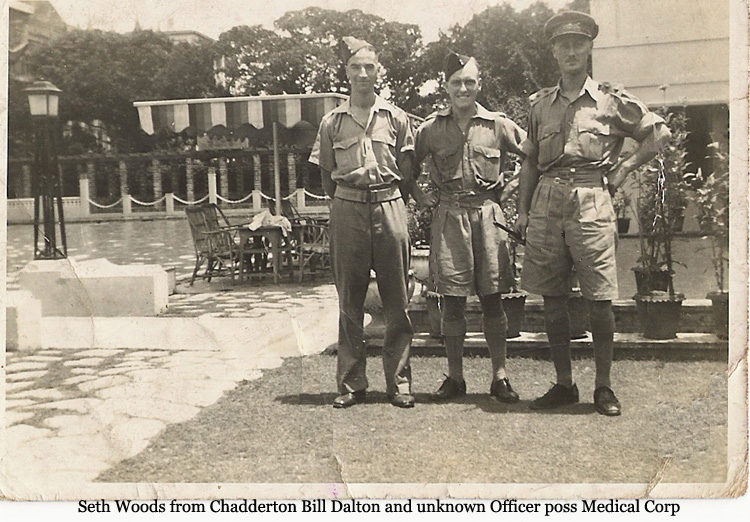
Mills Depot, Bill regularly drove for the following Officers: From March, 1940 when Bill was conscripted into the Army until approximately August/September, 1941 he remained at either Wellington Barracks or Lower- Croft Mills. During these early days of Army life Bill freely admits that he had a relatively easy time of it and was able (as and when granted leave) to travel to and from his home in Croston Village on his Rudge motorcycle. (See photo gallery) However, Bill's apparent cushy Army life was about to change for ever, when in September, 1941 he was posted to the 10th Battalion the Lancashire Fusiliers. Bill's life in the Army had taken a serious turn. He was shortly to go to war! A war that he would be extremely lucky to survive The 10th battalion the Lancashire Fusiliers (along with the 9th battalion) was raised on the same day, 4th July, 1940. The 9th were later converted into a RAC Regiment, but later disbanded and dispersed. The 10th battalion however remained intact, and after initially being formed at Exeter from cadres supplied by the Devonshire Regiment and the Somerset Light Infantry, the Battalion received its first intakes of recruits at Coatbridge, near Glasgow. The battalion's first commanding officer, Lieutenant- Colonel G .C. H. Stannus, was later to go on to command the battalion with great distinction and led the battalion in their first operations in Burma. Bill was later to be assigned as his driver and drove his "CO" for many thousands of miles. He speaks of his former CO with huge respect Following its initial establishment
and shake down as a new unit, the 10th battalion was posted to the Lowestoft
area on the east coast where they were employed on Coastal Defence Duties. He was initially billeted in the Village of Adlestrop 3 miles east of Stow-on-the-Wold and recalls staying at Dalesford Hall. The battalion however was only there for a very short time before being re-located to Unsworth Mills, near Whitefield not far south of Bury. (this area is now a huge housing estate) It was whilst stationed at Unsworth Mills and in preparation for service overseas, that Bill recalls the story of the "disappearing Rudge Motorcycle". As previously mentioned Bill was a very keen motorcyclist and the owner of a very fine ' Rudge '. Upon his return to the Bury area, he had once again begun to use his motorcycle, which whenever possible, he kept at Unsworth Mills. At some time in perhaps late November, 1940 (Bill cannot recall exactly) the battalion (to a man) found themselves confined to barracks. This it later transpired was due to the battalion's imminent departure for "duties overseas". Bill was very concerned that he would quite literally have to dump his motorcycle at the camp for the "duration". Not wishing to leave what was in fact an expensive piece of machinery to the attentions of any passing Tom, Dick or Harry Bill decided to speak to the then RSM 'Bert' Whitcher.
RSM Whitcher) however, issued Bill with the sternest of warnings (as only an RSM can!), regarding the dire consequences that would befall anyone leaving camp in contravention of the confinement order. Bill had known 'Bert' Whitcher for quite some time and they had in fact got on quite well. Whilst been warned of the serious repercussions of failing to obey orders Bill noticed something, something special………… a little twinkle in the RSM's eye!!! Bill therefore decided that he was going to risk it, and set about a devious plan to sneak the bike off camp and get it back to his home in Croston Village. A short time later he put his plan into action, and with the help of several mates he started the bike up on the pretext of 'showing off' the bike to the assembled group. Anyone passing he believed, would assume it was just a group of enthusiasts talking 'bike'. However Bill's motives were far more devious. He was actually getting the bike warmed up………...ready for the escape! His plan though had one huge potential drawback. 'Bert' Whitcher! The topography of the camp and lay out of buildings meant that to leave camp there was no other option but to have to pass directly in front of the RSM's Office /Billet. Surely he would be heard. Again, a further complication was that Bill could not be seen to be riding a civilian motorcycle whilst in Uniform, and therefore had to opt for a disguise from a mixture of civilian and military clothing. Cutting this story slightly short Bill, with a sharp intake of breath a lump in his throat and a thumping in his chest decided that the time had come and he roared off straight past the RSM's Office as quickly as he dared. Much to his own surprise as anyone else's he made it out of camp without being challenged, and rode along a dirt track, and then by devious pre planned route headed off through Unsworth, Whitfield and Radcliffe. His luck however was about to run out. He was spotted………….. spotted by the boys in blue!! At around that time the local Constabulary had started using MG Sports Cars as Road Patrol Vehicles (most probably 2 seater MG TA's). The chase was on! Had he been seen or heard leaving camp??........ had the Police been informed and were they actually looking for him?.....a whole host of questions went through his mind…….is Military clink really that bad??!! Bill was not going to hang about waiting for the answers ….he was off! What followed as described by Bill would undoubtedly have formed a brilliant script for an episode of the Keystone Cops.
It will be enough to say and as an indication of how long and far the chase ensued, that Bill finally shook off his pursuers on the far side of Bolton near the Horwich border!!! Bill thankfully, finally made it back to Croston Village without further incident…… A relative later drove him back to Unsworth where Bill sneaked back into camp and anxiously asked if he had been missed? Yes you daft **^>++!!!…… you should have been on guard two hours ago!!!! Thankfully a fellow Fusilier had stood guard duty in his place, and as far as anyone knew Bill had not been missed. As a post script to the story, Bill says that the RSM 'Bert' Whitcher never asked him about the whereabouts of the bike..………..but he knew……..he knew alright!! 'Bert' was to survive the war, and in the early 1950's became instrumental in organizing Burma Star Veterans re-unions at the Derby Hotel, Bury and later at the 55 Club in Preston. Within days of the disappearing bike trick, the realities of war time Britain became very apparent and it would be almost four years before Bill again rode his beloved Rudge…….. At the beginning of December, 1941 in a flurry of activity, the battalion departed Unsworth Mills Camp, and was transported by train (leaving Bury - Bolton Street Rail Station) to Liverpool Docks. There the battalion was embarked onto the SS Reina del Pacifico, which departed Liverpool at 0400 hours on the 15th December, 1941. (See.www.cofepow.org.uk/pages/ships_reina_del_pacifico.htm.)
Built in 1931 for the Pacific Steam Navigation Company, the ship was initially used on the Liverpool - Valparaiso route, but was brought into service in 1939 as a Troop Ship and saw service as such until 1946. During that time she conveyed quite literally thousands of troops throughout the world. After War Service, in 1947 she
was sent to shipwrights for a refit and refurbishment prior to being returned
to commercial service. Moving back to our story. Having departed Liverpool, the ship made its way to the Clyde Estuary in Scotland, and then onto waters off northern Scotland. There it joined a convoy which Bill recalls as numbering as many 70 ships. This was a very large convoy for the early 1940's. The threat from German 'U' Boats was a continuing serious danger to shipping as the convoy set sail. Thus the convoy embarked upon a zig-zagged pattern, initially west through the Atlantic Channel and into the North Atlantic then turned due south, their destination? Now, there is a question. Although Bill and his comrades were never officially told of their ultimate destination, it was generally believed by all on aboard that they were headed for Singapore to bolster the Garrison. As readers will know, Japan entered the Second World War on that "date in infamy" 7th December, 1941, and thereafter made quite startling advances throughout the Pacific Basin and South East Asia. The Japanese advance down the Malayan Peninsular towards Singapore, was to have serious consequence for Bill and his comrades aboard the SS Reina del Pacifico. See www.ww2australia.gov.au/japadvance/malaya.html Newspaper reports at the time quoted Winston Churchill as saying that "Help was on the way!!" (see copy Singapore Times in Bill's Photo Gallery). Sadly, as it turned out for the troops Garrisoned in Singapore, very hollow words indeed………. they were about to undergo five years of living hell! Whilst the as yet unknown carnage and depravity of the Imperial Japanese Army steamrollered their way throughout the many dependent territories of South East Asia, Bill and his fellow Fusiliers passed the time as best they could onboard ship. Thankfully they were oblivious to the horrors about to unfold! The SS Reina del Pacifico continued
on its journey southward, and after calling at Freetown to re-fuel and
take on supplies, passed down the African west coast, rounded the Cape
of Good Hope, Bill along with many others was granted a 24 hour shore pass, and spent a very enjoyable time in the company of several ex- pats who had taken it upon themselves to play host to the transient soldiers. Sadly, their chance to "stretch their legs ashore", soon passed, and they were very quickly on their way again. The New Year had turned, and the convoy of ships sailed north along the east coast of Africa without incident. They eventually entered the Gulf of Aden, where they remained at deep anchor for several days. Unknown to Bill and his comrades onboard the SS Reina del Pacifico, whilst they had been travelling out to the Far East the Imperial Japanese Army and Navy had continued their advances throughout South East Asia, and Singapore was now in imminent danger of being over-run. Bill recalls the date as being somewhere in mid January, 1942 and after several days at anchor in the Gulf of Aden the SS Reina del Pacifico departed the convoy, alone, and headed straight across the Indian Ocean as fast as her propellers could rotate! They were heading for Bombay, India! Bill's assumption (probably correct) was that the convoy had been held at anchor whilst the 'powers that be' back in the UK decided upon the best course of action to take in view of the potential loss of the Garrison in Singapore. Whatever the true reasons were, it was thus that Bill and his comrades of the 10th battalion found themselves landed at Bombay on the 27th January, 1942. The surrender of Singapore occurred
on 15th February, 1942.
There, the 10th battalion relieved the 1st battalion of the Lancashire Fusiliers, who were to later mark their own place in history. Bill was only stationed at Quetta
for 3 or 4 weeks before being At around this time, perhaps March / April, 1942 it is Bill's recollection that the Russians had not yet sided with the Allies, and there was a firm belief (particularly in Whitehall), that the Russian Armies might try to take advantage of the turmoil unfolding and force an entry into India across the Afghanistan Border. Throughout his time at Spinnateezi, Bill was engaged on border protection duties (foot patrols), and he, along with his colleagues were assisted on their patrols by "Pathans", the local hill tribesmen. The Pathans were recruited and paid by the War Office. Bill recalls them as being very independent, and that they supplied there own equipment, particularly their own rifles. He recalls only one rule applied where the Pathans were concerned, you never ever, ever, tried to touch their rifles! Bill cannot recall for sure how long he was at Spinnateezi, but he and the rest of the company were certainly back with the main battalion by late May early June. At the beginning of June, 1942, the battalion was unexpectedly given secret orders, and shortly thereafter transported across India to Comilla in East Bengal. (now forming part of Bangladesh) The journey from Quetta to Comilla was undertaken by troop train, and took 8 days and 8 and very long nights. Bill and his fellow fusiliers found themselves transported from the mountainous regions of the North Western Indian / Afghanistan Border where the weather was 'bracing' by day and "bloody freezing by night", to the hot tropical jungles of East Bengal.
The sudden move to East Bengal transpired to be part of early preparations for impending operations in the Arakan Region of Burma (see maps at www.burmastar.org.uk/arakan_mountains.htm (and www.burmastar.org.uk/burmamap.htm) Within days the battalion moved yet again to Chittagong, and took its place in 123 Indian Brigade of the 14th Indian Division, together with two Indian Regiments, the 8th Baluch Regiment and the 1/15 Punjab Regiment. The Brigade was under the Command of Brigader B. Hammond. See www.burmastar.org.uk/14thind.htm The 14th Indian Division, later to be commonly referred to as the Eastern Army was originally formed in May 1942 by Major General H. H. Rich. The Badge for the Division depicts a Mountain Range in Black (the center peak being Takath at 10,000 feet overlooking Quetta set in a white frame on a black background, the frame taking the form of a letter Q to link with Quetta. The 14th Indian Infantry Division should not be confused with the Fourteenth Army, the "forgotten army", who were formed later. All of the above in truth really
meant nothing to Bill and the others The object behind concentrating
the Division in the Chittagong region was to give all the troops, where
possible, a period of concentrated training in jungle warfare prior to
the planned operations in the Arakan. Regrettably, during this period, the Division was called upon to meet a huge number of extra demands for internal security duties, so when they did finally met the Japanese they were still comparatively inexperienced in jungle fighting. At that time the Japanese Army had gained a reputation for invincibility that was rather depressing for morale. However, as later events were to prove, as soon as the British and Indian Armies had learnt jungle warfare techniques, they were more than a match for the Japanese. It would be very easy at this stage to submerge the reader in a myriad of facts, figures and information about the events leading up to, and the need for the operations in the Arakan Region. However, in order to place in
context the events about to be described, it is necessary to make some
reference to the reasons surrounding what became known as the First Arakan
Campaign. NB: Further detailed and comprehensive information can be found in the book 'History of the Lancashire Fusiliers 1939 - 1945' by John Hallam (Major). His book has proved an invaluable resource in writing Bill's story. Copies are readily available through most libraries
Fortunately two factors conspired against the Japanese; first, the difficult nature of the No Man's Land that lies between Burma and India, and, second, the necessity to halt the advance and consolidate their position after the rapid advance which had stretched supply lines to the limit. The Arakan 'Yoma', a range of
steep, jungle clad hills and mountains passable by only a few rough tracks,
runs parallel with the coast from the Indian frontier down to the Irrawaddy
Delta. The buildings in theses villages were mainly constructed of local materials (bamboo), and in some cases had the luxury of a corrugated tin roof. Invariably they were built up on stilts in an attempt to thwart the effects of the monsoons. Near the coast, the country is an utter maze of creeks and mangrove tidal swamps, through which communication is difficult in the extreme, and only possible by native boat. The whole area is intensely malarial and a serious threat to good health. Other than from the period between
November and the middle of May, the Arakan region it is exposed to the
full forces of the southwest monsoon, with its torrential rains and damaging
winds of unbelievable ferocity. The operations for the Arakan planned for the winter of 1942 -43 were, by intention, limited in their scope, and were intended to recapture the Port of Akyab and the reoccupation of Upper Arakan. The first part of the operation involved pushing columns south from Chittagong towards the Burmese Border, in order to establish and improve communications, and to build up reserves of both men and equipment for an advance into the Arakan Region later. Again at this stage of writing it would be possible to give a plethora of information about intended tactics, planning and movements etc but that information can be gleaned from other sources. It would suffice to say at this stage that Bill now found himself in very different surroundings from the green fields of Lancashire, evenings out at the Palais de Dance in Bury, and Wellington Barracks. The tales of saluting KFS's, disappearing motorbikes and undone buttons seemed a lifetime away and had become a total irrelevance. The original plans for the recapture of the Port of Akyab had involved an assault from the sea, with elements of the 14th Division advancing down from Chittagong being a diversionary tactic, whilst the main force would attack from the sea. However, because of severe difficulties in locating sufficient Landing Equipment and supplies (being used by other theatres), the 'plan' was modified several times and led to the operations being delayed several times. A radically different assault plan was formulated and adopted, whereby the 14th Division was to rapidly advance down the Arakan to the southern end of the Maya Peninsula, and then launch an assault on Akyab, supported by an assault from the sea using whatever landing crafts that had become available. It was in accordance with this modified plan that Bill's Brigade began to move forward during the latter half of October, 1942. However, one thing that had not been expected, nor in truth could have been foreseen was the unusual weather. As mentioned earlier, the Arakan Region is subjected to the full force of the southwest monsoon. In a 'normal' year, the monsoons could be expected to have finished by early November and not return until the following May. Sadly during the winter of 1942 - 43 the monsoons extended well in November and December. High winds and torrential rain were to make the troops existence, which was never comfortable to begin with, little short of a living nightmare! Moving through the jungles of the Arakan Region was not easy at the best of times (a wildly vast understatement), but to do so in 'full kit' whilst carrying heavy loads in the middle of monsoon conditions, is truly beyond description.
The mention of Ukhia brings to mind for Bill an incident involving one of his comrades, Jimmy Ince who came from Chorley. It can hopefully bring into focus for the reader the sheer desperate difficulties faced by the troops at this time. The approach to Ukhia was made during the early evening, and throughout that day the monsoon rains had made life for everyone virtually unbearable. They had been knee deep in mud travelling through difficult terrain, and the sheer physical strain being placed on the fittest and strongest of men was bearing down hard. At one point Jimmy Ince fell forward face down in the mud, undoubtedly from utter physical exhaustion? Jimmy just lay there. Bill quickly dragged him out of the quagmire, turned him over and began cleaning and clearing his nose and mouth of the mud and filth. Bill, in a very modest manner accepts that Jimmy would have without doubt, drowned in the mud had he not been rescued. Later that evening the battalion encamped at Ukhia for the night and Bill recalls up to one hundred men trying to sleep under one enormous basha that had been constructed. Throughout the night the monsoon with its heavy rain and wind continued relentlessly, and at one stage during the night Bill was awakened by the sounds and feelings of movement.
Jimmy Ince died that night. Bill says that Jimmy who was perhaps not physically the strongest of individuals had simply given of his very best and "had been walked to death". He was buried at Ukhia the following
morning. Bawli Bazaar is the junction point of the road from the north with tracks that lead south towards the secondary road connecting Maungdaw with Buthidaung, both of which had been occupied by the Japanese. Other tracks from Bawli Bazaar lead eastwards to the Kalapanzin River, and beyond that to the Kaladan River. Bawli Bazaar at that time, therefore, had a certain strategic importance. Whilst at Bawli Bazaar the battalion pushed companies forward to Goppe Bazarr and Taung Bazaar on the Kalapanzin River.
It would now be an easy trap for the writer to fall into and embark on a lengthy description of the military operations that followed which were varied, many and complex. However, to give clarity to Bill's story it will be necessary to describe in brief detail some of the operational events that took place during late December 1942 and January, 1943. (detailed account of operations at this time are contained in John Hallam's book) Following the first encounter
with the enemy the next step was to attack the enemy positions at Maungdaw
and Buthidaung, but preparations for these attacks were delayed by the
difficulties of moving and supplying troops in the intractable country.
Adding to their problems was the continuing freakish weather conditions which showed no signs of abating. Finally it was not until the middle of December, 1942 that the attacks could be launched. The division was led by 123 Brigade, and the 10th battalion passed the starting point during the night of 16/17th December. Having passed it, they bivouacked for the rest of the night and resumed the advance the following morning. By the time they came to within
a short distance of Buthidaung they had seen no sign of the enemy. A reconnaissance
party under Lieutenant Colonel Stannus then went forward of the main column
to investigate Buthidaung and found it clear of Japanese. Two days before Christmas, 'B' and 'C' Companies with Advanced Battalion Headquarters under Major A.A. McKay went by sampan to Taungmaw and Singgondaing, and from there pushed patrols forward to Rathedaung. They met no opposition. The rest of the battalion moved up to Kindaung on Boxing Day, and were ferried across the Maya River. Next day they marched to Taungmaw. During the early evening of December 27th, from Taungmaw, 'C' Company, under the command of Captain G.E. Pendlebury, moved by sampan to Kyaukbbinzeik, while from their advanced position at Singondaing 'B' company and Advanced Battalion Headquarters moved, also by sampan, down the river in the direction of Rathedaung. It is important to point out at this stage that Bill was in 'B' Company and his platoon sergeant at that time was Cyril Robinson. Reconnaissance patrols had reported that Rathedaung had also, like Buthidaung, been evacuated by the enemy. As the detachment came up to the jetty with the intention of landing and occupying it, they came under heavy fire from the bank. A heroic attempt was made to force a landing on the jetty, with varying success. The detachment was scattered into small groups during the turmoil that unfolded. Just prior to their arrival at the jetty, Bill, like any soldier worth his salt, had been trying to get some sleep in the bottom of the sampan and was awakened by one of his comrades with the words, "we're here Bill". He had just popped his head up and fastened his belt when the enemy machine guns opened fire.
Bill recalls that it was at this point that Major McKay who was not "but a yard and a half away" was shot in the head and fell back into the water. To use Bill's words "There was nothing I could do for him, I wish I could, but I couldn't". Frantic efforts were made to find cover from the enemy fire, and those who were able to make a landing (including Bill) made their way towards the square in the center of Rathedaung village. There the splintered individuals and small parties re-grouped under the command of Lieutenant Pierce. At was at about this point that Bill was separated from Cyril Robinson (his platoon sergeant) who was to lead a party back to the battalion by a different route that Bill was to eventually take.
The Story is headed: The Shambles at Raithidong This is a story from the first
Arakan campaign in 1943. At this time, I was a sergeant in the Lancashire
Fusiliers. Information had come to us that the Japanese had vacated a
place called Rathidong. which was on the river Mayu just above Akiam Island.
We left the sampans there and we moved towards where the firing was taking place. As we did so, I was suddenly halted by a Lancashire voice saying, "Halt, who goes there?" I recognized the voice as Sergeant Ron Southworth, so I said, Don't shoot, Its Robbie, me!!" and he said "advance to be recognized". After he recognized me I advanced and asked him what was going on. He said that the main body were now engaged with the Japs who were in the town. So I said the best thing to do would be to join the main body and see what was going on. So we joined the main body, which was roughly in the centre of the town and met up with Lieutenant Pierce.
We decided that he would give me a signal. Like a whistle, when he was clear of the river so that we could then move off ourselves. After some time, we got the whistle blast so I moved off to where I'd left the 2 sampans. But lo and behold, they'd gone. The sampan wallah had obviously taken them, with the blankets. So for a time I was in a quandary, wondering what to do, because we had no means of transport. I thought the best thing to do was to cross the chaung at the bottom of Rathidong, move due east, then cross the chaung further up and strike north back towards the battalion position, which was further north. We gathered the party together, which was approximately 20 people. There was Sergeant Southworth, Sergeant Hallowes, approximately 17 fusiliers, and myself. As senior Sergeant I took charge of this party. We then moved on and we came to a concrete raft across the chaung, which we crossed and walked south for perhaps ten minutes. Then I decided to strike east. This would take us as far away from the Japanese positions as possible. And into some shade which was provided by some wooed areas. We did this for some time, and then perhaps after an hour and a half, I decided we should lay up. So we positioned ourselves into a defensive area and laid up for perhaps half an hour. After this we struck off again up this chaung till we came to a man made bamboo bridge, which was a ramshackle affair which crossed the chaung at a narrower point. The tide was now ebbing, and these chaungs used to flow down and leave mangrove swamps at each side of these. I sent as many as possible across the bridge- most got across- and it left me and a fusilier, Joe Carter, on this side. I had my rifle and Joe had the bren gun. Anyhow Joe decided to try and get across this bridge, and he got so far and fell off. Of course, he fell off with the bren gun. I pulled him out of the mire, and I carried the bren for a time. We eventually struggled and got
across the bridge. We were now across the chaung and the obvious thing
now was to get back to battalion. The only way to do that was to strike
north. Having no compass and no means of directional finding, I decided
to work on the stars which were now well up, and the time must have been
perhaps midnight. Anyhow, we located the North Star in the sky and worked
on that for quite some time, keeping into the shadows of this heavily
wooded area. We must have worked on this for 2 or 3 hours, then we decided
to lay up again. It was kind of open scrub, and the sky was getting lighter.
I decided to let half the party After a time we went to sleep,
and when I wakened up everybody was asleep….if the Japs had have
come, they'd have had the lot of us! But fortunately they didn't. We set
off again and it was now getting light, and we crossed open scrub again
for some time, not meeting anything or anybody in any areas, till eventually
we came to another chaung. Luckily there was a boat at this side, on its
keel upside down. So giving 3 sharp cheers we turned it over on its side,
put it in the river, and it sank right to the bottom!!!!. On the other side of this chaung was a village which we came to know later as Thalindora, and we managed to entice two of the villagers across. They got us 2 sampans, which we neded for approximately 20 people, and we decided to get back to the battalion that way. So we sailed out of the chaung into the main river Mayu, and by now the tide had changed so fortunately it was taking us up stream. So we started making our way up the river Mayu. We got so far uo - we were making slow progress - when suddenly from up north, a British Spitfire came. We gladly waved to him, and what did he do, he decided to fire on us!!!! So he fired on us and we were over the side like wild ducks!! Fortunately, he didn't hit any of us, and he merrily went on his way. We got back into the sampans and made our way further up the river. It was now getting late again so we made very slow progress till eventually we joined the battalion at about 9 o'clock at night in a place called Zedidong. The RSM welcomed us quite freely with cup of tea and something to eat. They told us to get our heads down………….which we did. Moving back in time to the 're-grouping' in the village square in Rathedaung. Bill recalls being in a group along with Lieutenant Pierce discussing what would be the best course of action and at that time there was the sound of machine gun fire and general small arms fire all around. Lieutenant Pierce instructed four of the fusiliers to take the only one remaining sampan (the rest had floated away) and make their way back to the battalion and seek 'help'. Bill recalls thinking at the time and saying to another fusilier that it would be suicide and they would get blown straight out of the water the moment they appeared on the river. The four left and a short time later Bill and the rest heard "an almighty burst of machine gun fire, we have never seen any of those four again" (quote). Of the four, Bill recalls one was called Leslie Critchley and another was Tommy Goff. A short time later Lieutenant Pierce having located a 'dug out' canoe type of craft, instructed Sergeant 'Jim' Ward (from Liverpool) to take 10 men and try and make their way back up the Mayu River to the battalion. Bill was 'selected' as one of the party. Everyone knew, in light of what had happened to Tommy Goff and Leslie Critchley, that they were about to embark upon a highly hazardous journey. Sergeant Ward, who Bill knew quite well, commented to Bill about having the responsibility of the lives of men in his hands. It was Bill who suggested that if they were to take the same route as the others they to may well end up with the same fate. He therefore proposed that once in the boat, they should go straight across the river (an actual tributary from the main Mayu river at this point) and head for the far side. The river at this point was about 40 yards wide. The route oddly enough, would take them south towards the Japanese positions, but the hope was that the Japanese had not occupied the far bank. (everyone knew it was high risk and a gamble) Had they stayed on the same side of the river however and attempted to sail into the Mayu at that point they would have undoubtedly come under fire from the Japanese who had attacked the four man sampan. Sergeant Ward adopted Bill's plan. It should be pointed out at this time that the approach to the Jetty at Rathedaung was made in the early evening of December 27th and that by now dark had set in and that they were operating in moonlight. The first problem to be overcome was getting across the tributary without being heard. It was suggested that paddles should not be used and that they used their hand as 'paddles' to keep noise to a minimum. They finally reached the far
side of the river and were able to use the riverside bushes and mangrove
roots as cover. Again with the need for utmost silence, (it was not known
if this side of the river was occupied by the Japanese) they began to
pull themselves along the river bank hand over hand along using the bushes
and mangroves until they reached the main Mayu River. In a modest understatement Bill simply says of the event "We were lucky, it came off". Sometime later, Sergeant 'Jim' Ward confided in Bill that he was thankful that he had come up with the plan. He also expressed to Bill his concern that he had a 'feeling' that he was not going to "get through all this". Sadly, very prophetic words, in early March 1943 he was killed in action. He was aged 37 years.
In moving our story forward it is necessary to go back in time to events which no doubt, were to form the basis of the life long friendship between Bill and Cyril Robinson. (apart from the fact that Cyril was instrumental in saving Bill's life on at least two occasions!!) As mentioned earlier, the 123 Brigade and the 10th battalion after many unexpected delays finally began the advance towards the Port of Akyab during the night of 16th /17th December, 1942. Pre planning had foreseen the need to attack the tunnels running through the mountains, connecting the villages of Maungdaw and Buthidaung which were occupied by the Japanese. At around that time Cyril Robinson was a sergeant in charge of a guerrilla platoon and Bill was a member of the platoon. The platoon was made up entirely of single men and they were to be given what might be termed as "the more difficult tasks". One of these "difficult tasks" was to attack the tunnels linking Maungdaw and Buthidaung.
It was decided that I would take the guerilla platoon down to the east tunnel. On the 17th December, 1942, we would attack the tunnel whilst the battalion would attack a village known as Letwidet. But the plan was that I would leave the battalion 10 days before they moved, with complete radio silence and no communication at all. However, the Japs had vacated both the tunnels and Letwidet and moved further south. But we had no means of communication
when I moved off, a week before the battalion. (Incidentally, on our way
to these tunnels, we passed a place known as the Admin Box, which later
became famous for a battle). It took us a week to get there, but we duly
arrived at our position, at about 6 o'clock in the morning. We were sitting
on top of the tunnel and it was pouring down. At this time, there were 2 bombers
which had been detailed to bomb Letwidet, along with the attack from the
battalion. They moved down a position to attack it, and we attacked the
tunnels. Our position was slightly above the position of the tunnels,
because they had been built on a road which cut through the mountain side.
So we were higher than the road. The road levelled out, then dropped away
again. What happened was that the Japs had vacated this position, without anybody knowing. Due to this radio silence that had been imposed on us by the move south, we weren't aware of this fact, and you've a job to tell the difference between a Japanese in the monsoon in a rainmac, and a 15th Punjab! So that was the cause of the mix up. Anyhow we eventually formed up in position. The officer liaising with our battalion must have been from the Punjab. The battalion in the meantime had simply walked into Letwidet, which had been vacated by the Japanese. So we marched the 5 miles to Letwidet. From Letwidet, they'd walked into Buthidong, which was then a navigable port on the river Mayu, the last port where mechanized vehicles could use the river. We joined the battalion there, and we were put into the village school. We stayed there for a time and celebrated Christmas Day 1942 in Buthidong. While we were there, a patrol went out from 'A' company under Sergeant Burns, and he brought back 2 brothers, part of a native tribe known as the Mogs who were joined up with the Japanese. These brothers were known as the Kings of Burma, and he'd captured them and brought them back. We stayed about a week in Buthidong. The plan was to move further down the river, and proceed down with this attack on the Japanese, the main objective being Akyob Island which was right at the bottom of the river. On the West bank of the river at Buthidong were 2 sandstone plinths. Lying on top and facing the river were 2 lions pr sphinx like figures. These were thought to be local deities and were called Chinths. This is thought to be the word from which Wingates force derived its name: the Chindits.
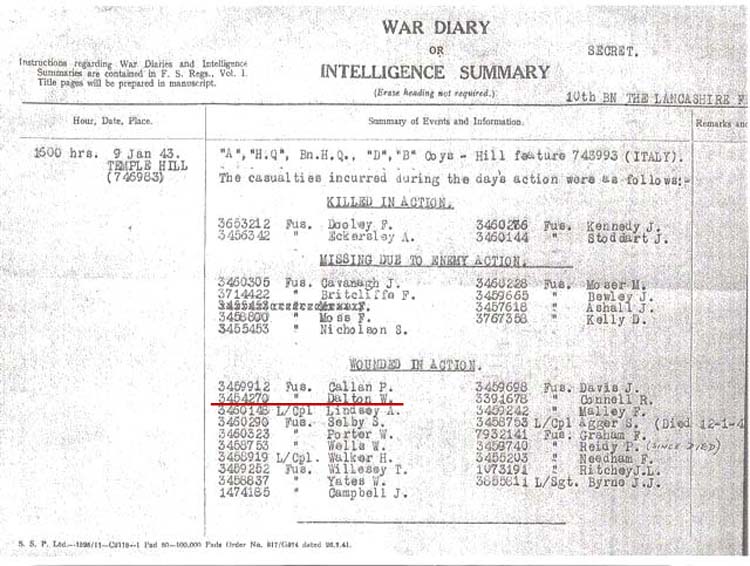
Following on from the aborted attack on Rathedaung the battalion reformed and embarked on several operations, and again the complexity and variety of those operations would take too long to describe here. Needless to say, the fighting continued, and during the period late December into early January a number of assaults took place in and around Rathedaung including a further aborted assault on Rathedaung. During this time planning took place for an assault in late January, 1943 on Donbaik and on 18th and 19th January, 1943 an attack was made. The Japanese sadly, were prepared for it, and it failed. Orders were then given for 123 Brigade to prepare a fresh attack on Rathedaung. Prior to the attack on Donbiak the battalion was engaged in a series of operations designed to soften up the enemy's defenses north of Rathedaung and from 9th to 19th January, 1943 was engaged in continuous operations. The 9th January, 1943 was to be the day that Bill got shot. Cyril Robinson wrote about it thus: Following the stories I've told about the Arakan Campaign, on 9th January, 1943, we were at a place called Thalindora. The battalion had been instructed to attack the features beyond Thalindora, leading into Rathidong. This was a densely wooded area with hill tracks and the plan was that C Company and A Company would go in advance companies. B Company would be in reserve and the battalion would follow up. We crossed the chaung after a small bombardment or two by 2 Blenheims. C Company met stiff opposition and so did A Company. So it was decided to advance B Company and take up the attack against the Japanese. We crossed the chaung and I had no platoon officer, so I was acting as platoon officer with Sergeant Southworth as my platoon sergeant, and Billy Dalton a fusilier as my platoon runner. His position was in advance of me. We went through some deeply wooded scrub land and he was perhaps 50 yards in front of me. We'd just turned this corner coming out of cover and he was going along this track towards the cover again, perhaps 100 yards in front of him. Suddenly we saw, well heard, as machine guns opened up and I literally saw bullets dancing along the ground, coming towards Billy Dalton. He was in front of me, and of course one struck him, it must have struck him and he went down. So without thinking……….you don't think about these things at the time, you just do it, I dashed out grabbed him and pulled him in. What had happened was that a bullet had struck him close up in his right groin and I think he was actually bleeding to death, I pulled his pants down and when I looked there was a gaping hole in the top of his groin and his eyes kept rolling in the back of his head. We have a field dressing on part of your uniform, it's a big piece of wadding, so I pulled this out and stuffed it into his wound. I know nothing about medical things but I did just that and then called up for the medics. Percy Ely, who was our sergeant in charge of all the medical side, came running up, looked at this and he got a big wad out and filled it with Vaseline and bunged that in the wound and then of course we shoved him back. From then on of course we went into this battle. It was a battle of nothing actually, we advanced and reached stalemate as it were, because we laid up for the night till we decided what to do the following morning. As a matter of fact we were pinned down for at least 4 days before we moved again. And that's the story about Billy
Dalton and his wounded leg
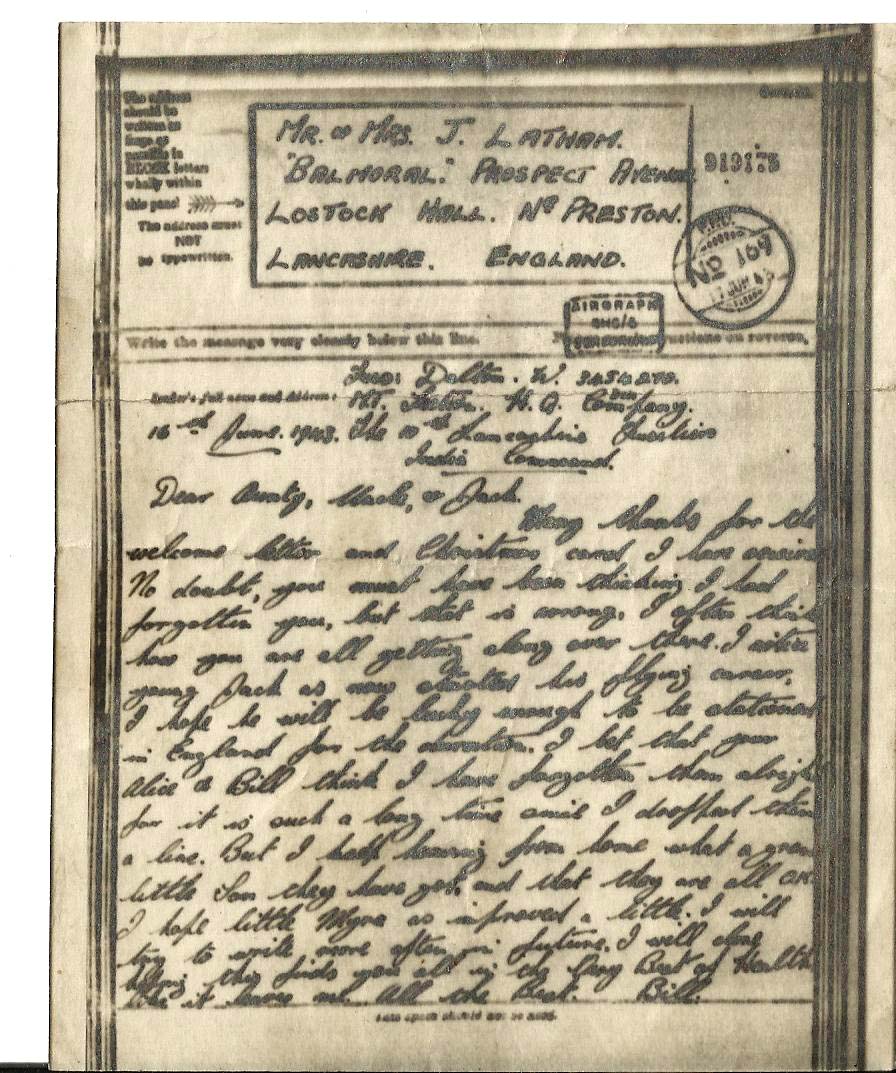
As one might expect given the circumstances, Bill's recollections of what took place thereafter are rather hazy. He was however 'passed back down the line' and carried by 4 Burmese or Indian stretcher bearers to the river where he was placed in a boat with other wounded men. Bill says that Sergeant 'Percy' Ely who undoubtedly saved his life was also instrumental in saving numerous other soldiers lives during their time in Burma, many, many of whom but for his 'medical' skills would have never returned home to their families. Percy was to survive the war and attended the re-unions in Bury. Bill can recall to this day the moment after he had been shot, placing his hand over the wound and with each heart beat, blood was spurting out between his fingers. Percy Ely's prompt action to stem the flow of blood certainly saved Bill's life, who was there and then quite literally bleeding to death. Sadly others who were also caught up in the same action were not so fortunate. Bill recalls a Fusilier Sam Agger who was virtually along side him. He received fatal wounds. By total contrast, others had what can only be described as near miraculous escapes. Bill brings to mind a fusilier who must be one of the luckiest men on the planet, Harry Halliwell, who came from Oldham. Harry was hit by a machine gun burst of nine bullets which tore into the side of his trunk and inside his arm. He must have been turning at the time. By some miracle, all nine bullets (that left a pattern down his body) although tearing off 'lumps' of flesh, actually missed any thing 'vital', with none hitting any bones! Harry Halliwell survived the war and returned home to Oldham. Moving back to our story, After having been carried by stretcher back to the river, Bill and three other wounded men were placed in a boat. They then made there way back to Maungdaw, a journey that took a day and a half or perhaps two. There, he and the others were admitted to a Forward Treatment Centre which had been set up under canvas. Bill describes it as being makeshift and holding only the very basic of medical equipment. He was seen by the Units Doctor (a Major) and underwent treatment to stabilize his condition. At that time it could not be determined if the bullet that had hit Bill had passed through his body or not. The absence of an 'exit wound' suggested that the bullet may have still been inside. Because of the basic equipment held at the Forward Treatment Centre (no x ray equipment etc) it was decided to 'leave well alone' for the time being. Also, it had become apparent that the bullet may have hit the sciatic nerve, because one of Bill's legs had lost all feeling. A couple of days or so later Bill mentioned to the orderly that he thought he could feel a hard sore lump in his buttock. The Doctor was summoned and he considered it a possibility that the 'sore lump' was the 'missing bullet'. The Doctor asked Bill what he wanted him to do about it and Bill suggested that the Doctor "get the knife in and dig it out". Thereafter by means not known to Bill, he was laid unconscious (possibly by ether) and when he awoke the Doctor presented Bill with "the bullet out of your backside" (See photo gallery) From the Forward Treatment Centre Bill along with many other wounded men were transported by various means and finally by medical troop train to Barelli Hospital (BMH) in India. Bill recalls the journey as being rather unpleasant and that the soldier in the cot opposite to him (all were lay down on stretchers/ cots) had an arm blown off and an orderly was regularly treating the open wound. Not a pretty site to see says Bill. Bill recalls that they all arrived at Barelli in a very 'poor state' having remained unwashed and unshaved for a long time. Most had beards of sorts and were in a very unkempt condition. "It was absolutely glorious being placed in a bed with sheets!!.......is one of Bill's lifetime memories of his arrival at Barelli Hospital. He was to stay there for several weeks. During his time at Barelli Hospital, Bill came into conflict with one of the Doctors (a Major) who was returning soldiers 'back up the line', who he felt had been 'swinging the lead'. It was clear to Bill and others around him that anyone thinking rationally would see that many being returned to their units, were just not yet fit enough to be returned to frontline duty. It would suffice to say that he (the Major) and Bill had a moment where 'they expressed their views' and Bill asked to be moved from Barelli Hospital. His 'request' was granted and Bill, rather than being moved to another hospital was sent to a Transit Camp at Gaya. Upon arrival there, he (like all other new arrivals) was seen by the Medical Officer (M.O.) The MO having examined Bill was appalled that he had been sent to a Transit Camp. He considered Bill's medical condition so poor that he immediately had Bill admitted to the hospital at Gaya Bill was to spend several weeks at Gaya Hospital during which time he began to get the feeling back in his leg. In fact he began to feel so much better that he was getting bored and asked to given a job. He was given the task of guarding the fresh water tanks!! Bill cannot recall exactly, but in possibly late May early June, 1943 he was considered 'fit for return to unit' and rejoined the 10th battalion who by this time had been withdrawn from the Arakan and were then based at Ranchi in Bihat State, India. Shortly after his return to the 10th Bill was appointed as the 'CO's Driver' to Lieutenant Colonel Stannus who at that time was still commanding the 10th. Bill was also promoted to Lance Corporal. Military etiquette deemed that a CO's driver should hold the rank of L/Cpl. In July, 1943 the 10th move to Fyzabad, where it was employed on internal security duties. Whilst at Fyzabad, Lieutenant Colonel Stannus completed his tenure of command and handed over to Major (Basil) J. Leech. (Bill recalls his batman being a Fusilier John (Jock) McGregor). By a strange quirk of timing, quite recently Brigader Basil J Leech's medals (as he later became) were for sale on the internet. At a time unable to be recalled exactly by Bill, the 10th was also commanded by Lieutenant Colonel J.K.Smith who had been a former pilot and wore 'wings' on his uniform. Again Bill was his driver.
In December, 1944 the 10th battalion were joined at Lucknow by the 1st battalion, back from it's participation in the Second Chindit Expeditions. In February, 1945 the 10th returned to Ranchi, and there became a training battalion of the British Reinforcement Training Group. During his latter time in Ranchi, Lucknow and Fyzabad Bill recalls a number of incidents which, whilst being of no military historical interest, may amuse the reader. On one occasion Bill was required to make an early morning trip to collect company commanders who were due to attend a CO's Briefing. The companies were scattered throughout various locations, and in order to collect everyone and have them back at HQ in time, Bill left HQ well before breakfast time. Having completed the task, Bill decided that his breakfast was long overdue. As he entered the Mess Hall however, he was stopped by Sergeant 'Jobsworth'. "And just where do you think you are going?"…."Going for my breakfast" replied Bill. "Oh no you're not, standing orders clearly state that breakfast is served from 0630 until 0730." The time was about 0740 hours and Bill could see through the door that food was still displayed on the hot plates. Sergeant 'Jobsworth' flatly refused Bill entry despite Bill's explanation as to why he had not been during 'normal' breakfast time. Bill was having none of this, a quick word with the CO got him his breakfast!!!! and what happened to jobsworth……….well perhaps that is another story?? Again whilst stationed at Lucknow a further story comes to mind. Bill regularly took the CO and other officers to Brigade HQ and there he would often speak to a young English couple (civilians) who were employed at Brigade HQ's on the clerical staff. They would often arrive on bicycles so Bill presumed that they must have lived locally. Years later he was to be told that they were in fact the parents of Harry Webb…..none other than Cliff Richards. As a driver, and particularly as the CO's Driver, Bill was expected to 'be prepared' at all times for any mechanical breakdown. Thus wherever he went, and sometimes journeys could be hundreds of miles across virtual deserts, he always carried a large supply of spares. Not only would these comprise the 'common' items such as a fan belt for example, Bill would also take items such a spare water pump, spare carburettor (petrol was invariably dirty and blocked jets), spare distributor, tyre vulcanizing kit etc. etc. He says as a somewhat strange fact to recall that he always had around 30 gallons of petrol (in 2 or 4 gallon jerry cans) strapped to various parts of the vehicles bodywork. A mobile firefall in the making!!! In his photo gallery is a photograph taken in either Ranchi or Lucknow of Bill standing next to a Chevrolet Station wagon. (actually a British Army vehicle). Bill found this vehicle in an almost derelict state and subsequently replaced the worn out engine and steering gear and was to later drive this very vehicle for thousands of miles all over India. Bill says that the course at Lookers in Manchester came in useful after all!! As Bill points out "you can't call out the RAC in the middle of India if you breakdown!" At sometime in early 1945 the
battalion moved to Lower Darga Bill has a crystal clear memory of the day he left Bombay to come home. As he walked up the gangplank to board the M.V. Cythia it came to mind that it was in fact his 29th birthday!! Heading home was the best birthday present he could ever have wished for! The journey home was a lot quicker than the journey out and took about three weeks (via the Suez Canal). Whilst travelling home, Japan surrendered (2nd September, 1945). Bill arrived back with the rest of his detachment in Liverpool (surprisingly he cannot remember the date but it must have been late August or very early September) They were immediately transported by train to Hunstanton on the East Coast. There they were billeted in private houses that had been commandeered during the war. Bill recalls that at the time their must have been around 9,000 plus soldiers in and around Hunstanton and along the East Coast awaiting demobilsation. Apart from a couple of moves to Bedlington where Bill worked for a short time in the clothing stores and a later move to York, Bill like many others was during this time 'kicking his heels' awaiting 'demob' Again, perhaps somewhat surprisingly, Bill cannot recall the actual date of his 'demob'. That said he is confident that it was during October, 1945 when at York he was finally discharged from the army with Demobilsation Group 26. His souvenirs? one trilby hat, one demob suit…………… and a Japanese bullet!!!
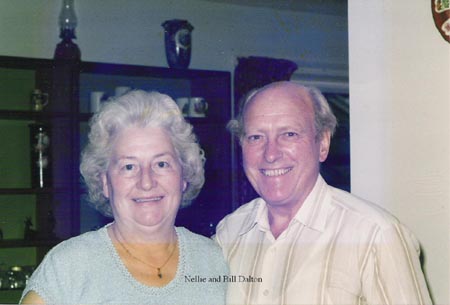
Bill returned to the village of Croston and resumed his life. In 1947 Bill married Nellie Sutton, a local girl and they were to go on to have two children, John and Audrey. He now has four grandchildren one of whom, John's son Lee is carrying on the family tradition and currently serving as Craftsman Lee Dalton 25132656 REME, 38 Engineer LAD (Light Aid Department). Claro Barracks, Ripon. Bill has applied through the Big Lottery 'Heroes Return' Scheme to re-visit Burma in the near future. If he does not get to go, then it really is a sad old world is it not???? XX
Photo Gallery XX
Sadly Nellie did not live to see it………she died in July, 2004 following a short illness. She was married to a true Lancashire Hero G Pycroft
Submitted by Amanda Carr |